How to Groom a GoldenDoodle at Home? Mat-Free 101 Grooming Guide

Quick Summary

To groom a Goldendoodle at home, brush and demat the coat completely with a slicker brush and metal comb. Bathe using dog-safe shampoo and conditioner, and blow-dry completely. Use clippers with guards for the body, blunt scissors for the paws/face, and pluck or clean the ears.

For the complete grooming foundation that applies across every breed, the complete home dog grooming guide covers tools, technique, and troubleshooting in one place.

My Goldendoodle came back from the groomer shaved down to the skin three times before I figured out why.

It wasn’t the groomer’s fault. Every time I dropped her off, the mats behind her ears and in her armpits were so tight they couldn’t be brushed out — only shaved. And every time I left thinking I’d been brushing regularly. I had been. Just not correctly.

I’d been brushing the coat’s surface while mats formed silently underneath. That realization transformed how to groom a Goldendoodle at home. And it’s about to change yours too.

What Makes Doodle Grooming Different From Other Breeds
How to Groom a GoldenDoodle at home

Doodles don’t shed the way most dogs do. The loose hair stays trapped in the coat, wraps around existing strands, and becomes a mat. Add a curly or wavy texture that tangles easily, and you have the highest-maintenance coat type most pet owners will ever encounter.

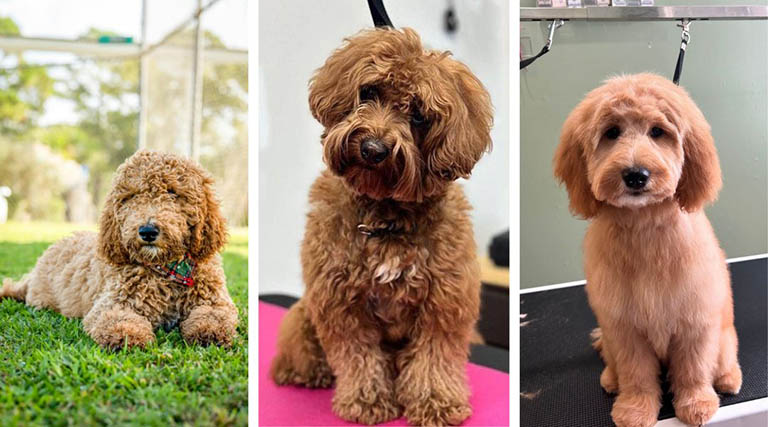
The other thing competitors don’t say clearly enough: the coat type determines everything. Not all Doodles groom the same way. A tight-curled Goldendoodle and a wavy-coated F1 Labradoodle have completely different grooming needs — same breed category, totally different coat behavior.

The 3 Doodle Coat Types — Know Yours Before You Touch a Brush

  • Curly coat (Poodle-dominant) Tight ringlets that spring back when pulled. Dense, single-layer coat. Minimal shedding but mats the fastest — within 48 hours of skipping a brush session. Needs brushing daily or every other day without exception. Professional clip every 6–8 weeks.
  • Wavy coat (F1 hybrid — most common) Loose waves, often with some undercoat. Moderate shedding. More forgiving than curly but still tangles quickly around friction points. Brushing 3–4 times per week. Clip every 6–8 weeks.
  • Straight coat (retriever-dominant) Lies flatter, closer to a Golden Retriever coat. Sheds more than the other two but mats less frequently. Brushing 2–3 times per week. Still needs regular trimming but is significantly more forgiving than curly or wavy.

If you don’t know which coat your Doodle has: pull a section of coat and let go.

  • Tight spring-back = curly.
  • Gentle wave = wavy.
  • Stays relatively flat = straight.

This matters because the brushing frequency and tools you need are completely different for each type.

The Doodle Home Grooming Kit — What You Actually Need

I’ve bought tools I didn’t need. Here’s what actually gets used.

  • Slicker brush with ball-tip pins — Your daily tool. The ball tips protect the skin during the frequent brushing this breed requires. Don’t use a cheap bristle brush — it doesn’t reach the dense coat near the skin and gives you a false sense of completion.
  • Metal greyhound comb — The non-negotiable quality check. After every brush session, the comb tells you whether you’ve actually reached the skin or just tidied the surface. If it snags anywhere, there’s a tangle you missed.
  • Detangling spray — A light mist before brushing reduces static and makes the brush move through the coat without yanking. I make mine — diluted dog conditioner in a small spray bottle. Works as well as anything sold specifically for this.
  • Dog clippers with guard combs — For body trimming every 6–8 weeks. Andis or Oster for dense Doodle coats — budget clippers heat up fast on thick coats and start pulling instead of cutting cleanly. A number 4 or 5 guard (half to three-quarter inch) for the body.
  • Curved scissors — For the face, paws, and leg shaping. Curved blades make the rounded shapes that define Doodle styling far easier than straight ones.
  • Thinning shears — For blending clippered and scissored areas. Without these, you get a visible hard line where the body clip meets the longer leg hair.
  • Moisturizing dog shampoo and conditioner — Both, every bath. Dry Doodle coats mat faster than well-conditioned ones. I use an oat-based formula for my dog who has sensitive skin — my DIY natural dog shampoo recipes include a gentle version that works well on all three Doodle coat types.
  • Mat splitter tool — For working through tangles that detangling spray alone won’t budge. Worth having before you need it.

How To Groom a Goldendoodle at Home: Step-by-Step

This section walks you through the full grooming process, from brushing to bathing to trimming.

The Goldendoodle Grooming Guide:

Generation, Coat Type & Grooming Routine — At a Glance

Most charts stop at “what coat will my Goldendoodle have.” This one tells you what to actually do about it — brushing frequency, clip schedule, and real matting risk by generation.

Generation % Type Shedding Frequency Schedule Risk
F1 Goldendoodle 50% Wavy / Fleece Moderate 3-4x per week Every 8-10 weeks ★★★★
F1B GoldendoodleF1 Goldendoodle × Poodle 75% Curly or Wavy Low Daily Every 6 weeks ★★★★
F1BB GoldendoodleF1B Goldendoodle × Poodle 87.5% Curly Very Low Daily, non-negotiable Every 6 weeks ★★★★★
F2 GoldendoodleF1 Goldendoodle × F1 Goldendoodle 50% Variable — wavy, curly, or straight Low-Moderate 3-5x per week (test by coat as it develops) Every 6-10 weeks ★★★★
Multigen GoldendoodleMultiple Doodle generations Varies Curly (most predictable) Low Daily Every 6 weeks ★★★★
Why this matters: the more Poodle genetics in the mix, the curlier and lower-shedding the coat — but also the higher the matting risk if brushing is skipped. F1BB and F1B coats need daily brushing without exception, while F1 wavy coats are more forgiving at 3-4x weekly. Puppies often shift coat type entirely between 6-12 months as the adult coat comes in, so recheck this chart once that transition happens.

Before the bath. Before clipping. Before anything.

This is the rule that competitors mention but don’t explain well enough: a wet mat doesn’t just stay a mat — it tightens into something close to felt. A tangle that takes ten minutes to brush out dry becomes impossible to remove wet without cutting. I learned this firsthand with a mat behind my dog’s ear that went through a bath before I caught it. It came out in scissors two days later.

The line brushing technique — the only method that actually works:

Divide the coat into four zones — rear, mid-body, shoulders and chest, legs. Work through one zone completely before moving to the next.

For each section: hold a layer of coat up with one hand to expose what’s beneath, brush that bottom layer from root to tip with the other hand, then let it down and take the next layer above it. You’re working upward through the coat in horizontal layers, brushing all the way to the skin with every stroke.

It feels slow. It is slow. It’s also the only technique that actually prevents mat formation — because you’re reaching the place mats form, which is against the skin, not on the surface.

The zones that mat fastest on every Doodle — check these first, every time:

  • Behind both ears (collar friction + moisture from floppy ear flaps)
  • Both armpits (leg movement creates constant friction)
  • Under the collar
  • Groin area and inner thighs
  • Anywhere a harness sits

After brushing, run the metal comb through the entire coat from root to tip. If it passes through with no resistance anywhere, the coat is genuinely mat-free. If it catches, you found something the brush missed — work it out before the bath.

For a detailed walkthrough, see my guide on how to remove mats from dog fur without cutting.

🛑 PRO TIP: NEVER bathe a matted dog—it will worsen the tangles!

Wet the coat thoroughly — Doodle coats resist water initially. Run your fingers through while wetting so water reaches the skin rather than sitting on top of the coat.

Dilute shampoo in a small squeeze bottle before applying — one part shampoo, three parts warm water. Apply from neck to tail in the direction of coat growth. Massage through to the skin. Keep product away from the eyes entirely.

Rinse until the water runs completely clear. Then rinse again. Shampoo residue left in a dense Doodle coat causes skin irritation and makes the coat dull and more prone to tangling.

Apply conditioner from mid-shaft to ends — not on the scalp. Two to three minutes, then rinse.

For a detailed walkthrough, see my guide on How to Bathe a Dog That Hates Water?.

💡 PRO TIP: A detachable shower head or pitcher helps rinse tricky areas like underarms and paws!

Air-drying a Doodle often leads to hidden mats forming near the skin, the moisture trapped in a dense coat for hours creates exactly the warm, damp environment where mats form and tighten from the inside out. By the time the coat looks dry on the surface, mats may already be forming underneath.

Towel press first — press, don’t rub. Rubbing a wet Doodle coat creates tangles.

Then blow-dry on low heat while brushing simultaneously through each section. This is how professional groomers achieve smooth, even coats — the brush and dryer work together, drying and straightening as you go. The coat needs to be fully dry at the roots before you stop — not just surface-dry.

If you’re planning to clip after bathing: the coat needs to be blow-dried straight before clipping. Clipping a coat still in its curly or wavy state produces an uneven finish.

Guard comb first. Every time. A number 4 or 5 guard for most Doodle body clips — leaving roughly half an inch.

Work in the direction of coat growth with smooth, even strokes. Neck to shoulders, shoulders to tail, down each side, then the chest and belly. Keep the skin taut with your free hand.

What not to clip with the body guard:

  • The face (scissors only)
  • The legs below the knee on most Doodle styles (scissor to shape)
  • The ears (thinning shears)
  • The tail (scissors)

For the teddy bear cut — the most popular Doodle style — the body is clipped short with guard combs, the legs are left longer and scissored into a rounded shape, and the face is trimmed with curved scissors into a rounded, soft appearance. This style is achievable at home once you’re comfortable with the clippers.

For a puppy cut — same length all over, no shaping — this is the most forgiving starting point for beginners. Same guard length everywhere, less scissor work required.

Use curved scissors for the rounded face shape. Blunt-tipped only around the eyes — Doodles have eyes that sit closer to the face than you’d think, and a dog who moves at the wrong moment with pointed scissors is a risk.

Clear the eye area first — this is functional, not just cosmetic. Fur growing into the eyes causes irritation and discharge. Trim the fur falling into the eyes before shaping anything else.

Then work outward from the eyes toward the ears, shaping the face into a rounded teddy bear appearance with small, deliberate snips.

The muzzle and beard: trim to neaten but leave slightly longer than looks right — it grows back fast and a too-short beard looks odd for several weeks.

For detailed technique, my guide on how to groom a dog’s face without stress covers this step by step.

For the teddy bear or lamb cut, the legs are scissored into a rounded cylindrical shape — even width from top to bottom, rounded at the paw.

For the paws: trim the fur between the pads level with the pad surface using a small trimmer or blunt scissors. Active Doodles collect an alarming amount of debris in untrimmed paw fur. Then round the outside of each paw into a neat circle. Full paw walkthrough in my guide on how to trim dog paw hair at home.

Doodle ears are a health concern, not just a grooming detail.

The combination of floppy ear flaps and (for Poodle-dominant Doodles) hair growing inside the ear canal creates conditions that trap moisture and promote bacterial growth. Doodles typically need ear checks at minimum every two weeks to maintain a healthy coat and prevent infection.

Wipe the visible interior of each ear with a cotton ball and dog-safe ear cleaning solution. Never push anything into the canal. A healthy Doodle ear is pale pink, has minimal odor, and has light-colored or no wax. Strong smell, dark discharge, head shaking, or scratching at the ears after cleaning — all worth a vet conversation.

For everything on ear health, my guide on how to clean dog ears safely at home covers what you’re looking for.

Trim every 3–4 weeks. Doodle nails vary — some are clear (quick visible as a pink line, easier to trim), some are dark (quick invisible, requires more caution).

For dark nails: trim tiny increments and check the cross-section of the cut surface after each clip. When a small dark dot appears in the center of the cut nail, stop — you’re close to the quick.

For resistant dogs, a nail grinder often works better than clippers — less shock, no sudden pressure sensation. My comparison of nail grinder vs clipper covers which suits different dogs.

For a full walkthrough, see my detailed guide on How to Trim Dog Nails at Home.

Doodles — especially Miniature Doodle varieties — are prone to dental disease. Brush 3–4 times per week with enzymatic dog toothpaste (chicken or peanut butter flavor — this actually helps with cooperation). Never human toothpaste, which contains xylitol, toxic to dogs.

For a detailed walkthrough, see my guide on How to Brush Your Dog’s Teeth at Home.

The Puppy Coat Change — The Phase Nobody Warns You About

Between 6 and 14 months, Doodles go through a coat change where the soft puppy coat is replaced by the adult coat. During this phase, both coats exist simultaneously, and they tangle together constantly.

No matter how diligent you are about daily brushing during the coat change, it’s very hard to avoid matting when going through this phase. The coat change happens when the puppy is around 9–12 months old as the adult coat grows in to replace the puppy coat.

Most experienced Doodle owners — and most groomers — recommend cutting the coat shorter during this phase rather than fighting it. A short puppy cut through the transition, then growing the coat back to preferred length once the adult coat is established, is far less stressful for both you and your dog.

Common Doodle Grooming Mistakes — And the Real Fixes

  • Brushing the surface only The single most common mistake. The coat looks smooth on top while mats form against the skin underneath. Line brushing from root to tip in sections is the fix. If your comb doesn’t pass through cleanly after brushing, you haven’t finished brushing.
  • Air-drying after baths Trapped moisture near the skin creates mats in a dense Doodle coat within hours. Always blow-dry, always brush while drying.
  • Using a bristle brush or human hair brush These don’t reach the dense coat near the skin on any Doodle coat type. A slicker brush with ball-tip pins is the right tool.
  • Skipping conditioner A dry coat tangles faster. Conditioner after every bath is not a luxury for this breed.
  • Letting too much time pass between full grooms Eight weeks is the maximum for most Doodle coats. Twelve weeks and the mat situation often requires professional dematting or a full shave-down.
  • Bathing before brushing Always brush first. A wet mat is not a mat you can brush out.
  • Swimming without brushing after Swimming and water play increase matting risk significantly. Always thoroughly dry your Doodle after water exposure and brush immediately once dry.

When Your Dog Needs Anal Gland Expression

Anal glands are small scent sacs located on either side of your dog’s anus. During normal bowel movements, they empty naturally—but when they don’t, they can become uncomfortably full, impacted, or infected. When this happens, your dog will show you clearly.

Signs Your Dog’s Anal Glands Need Attention:

The most obvious signal is scooting—that distinctive dragging of the rear end across the ground or carpet. You might also notice your dog excessively licking or biting at the base of the tail, sometimes obsessively.

A strong, distinctive fishy odor from the rear area is another telltale sign (and often the first thing owners notice). In more serious cases, you’ll see visible swelling or notice your dog showing clear discomfort when sitting or moving.

Why Professional Help Matters

While some experienced dog owners learn to express anal glands at home, most vets recommend leaving this to a professional—especially if your dog is in pain, showing swelling, or you’re unsure what you’re doing. Improper technique can injure the delicate tissue or cause infection. Many veterinarians include anal gland checks during routine wellness visits, and expression takes just minutes.

What to Do If You Notice Signs

If your dog scoots, has that fishy smell, or you see any swelling, contact your vet. They’ll examine your dog, determine if expression is needed, and rule out underlying issues like allergies or dietary problems that might be causing the problem in the first place.

Depends on coat type. Curly coats need daily brushing. Wavy coats need brushing 3–4 times per week. Straight coats manage with 2–3 times per week. During the puppy coat change phase between 6 and 14 months, daily brushing across all coat types is the only approach that keeps matting under control.

Run a metal comb through the coat from root to tip. If it passes through smoothly, no mats. If it catches — especially near the skin — you have a mat forming. Mats that the comb can work through with gentle pressure are manageable at home. Mats tight against the skin that the comb can’t pass through need professional assessment to remove safely.

The puppy cut — even length all over using the same guard comb everywhere — is the most forgiving for home groomers. No complex shaping. Imperfections are less visible at shorter lengths. The teddy bear cut is the next step once you’re comfortable with clippers and have started using curved scissors for the face.

Every 6–8 weeks for most Doodle coat types. Curly coat Doodles often need it closer to every 6 weeks. Straight coat Doodles can sometimes stretch to 10 weeks. Beyond 8 weeks on a curly or wavy coat without consistent home brushing, matting typically requires professional intervention.

Partially. Wavy and straight coats can be managed with 3–4 sessions per week using proper line brushing technique. Curly coats genuinely need daily attention. The technique matters more than the frequency — ten minutes of proper line brushing prevents more mat formation than thirty minutes of surface brushing.

Almost always a technique issue. Daily surface brushing — running the brush over the top layer of coat — leaves the underlayer untouched. Switch to line brushing in sections and verify each section with a metal comb. The comb is honest in a way the brush isn’t.

Both is the ideal approach. Home grooming handles the ongoing maintenance — the brushing, ear cleaning, nail trimming, and occasional bath — that keeps the coat in good shape between sessions. Professional grooming every 6–8 weeks handles the full clip and any areas that need precision. Doing both saves money compared to relying entirely on professional grooming and produces better coat health than professional grooming alone without home maintenance.

The Honest Reality of Doodle Grooming at Home

Doodles are beautiful dogs with genuinely high-maintenance coats. The surprise shave-downs happen — I’ve been through them. They happen because the coat got ahead of the routine, not because home grooming is impossible.

The routine that changed things for me: brush before bed, five to ten minutes, every other day for my wavy-coated dog. Metal comb through the high-risk zones every session. Full bath and blow-dry every three weeks. Professional clip every eight weeks.

Not complicated. But consistent. Consistency is the entire secret to a mat-free Doodle coat.

Leave a Reply

Your email address will not be published. Required fields are marked *