Your dog scratches after every bath, the “gentle” bottle you bought smells like a perfume counter, and somewhere online a recipe promises a homemade dog shampoo for sensitive skin that will fix it all. Can you actually make one safely?
Yes, as a gentle cosmetic wash, not as a treatment, and only with the right ingredients, a patch test and a complete rinse. This guide gives you two conservative recipes, names the unsafe ingredients crowding search results, and tells you exactly when to put the bottle down and call a vet instead.
Quick Answer
You can make safe, effective DIY dog shampoo at home using simple kitchen and pharmacy ingredients. Because a dog’s skin has a higher pH level (around 6.2 to 7.4) than human skin (around 5.5 to 5.6), you should never use human shampoo.
A gentle homemade dog shampoo for sensitive skin is possible as a cosmetic wash, not as a treatment. Patch-test first, rinse until the water runs clear, and make water-based mixes fresh each time. Leave essential oils out entirely.
Stop and call a vet for broken, raw, bleeding or oozing skin, hot spots, hair loss, ear infection signs, spreading redness, pus or a strong odour, or itching that stops sleep or lasts more than a few days. A homemade wash only cleans a healthy, unbroken coat gently. For the full routine this wash sits inside, read my complete guide to grooming your dog at home.
Homemade Dog Shampoo and Sensitive Skin: Why “Natural” Is Not a Safety Claim
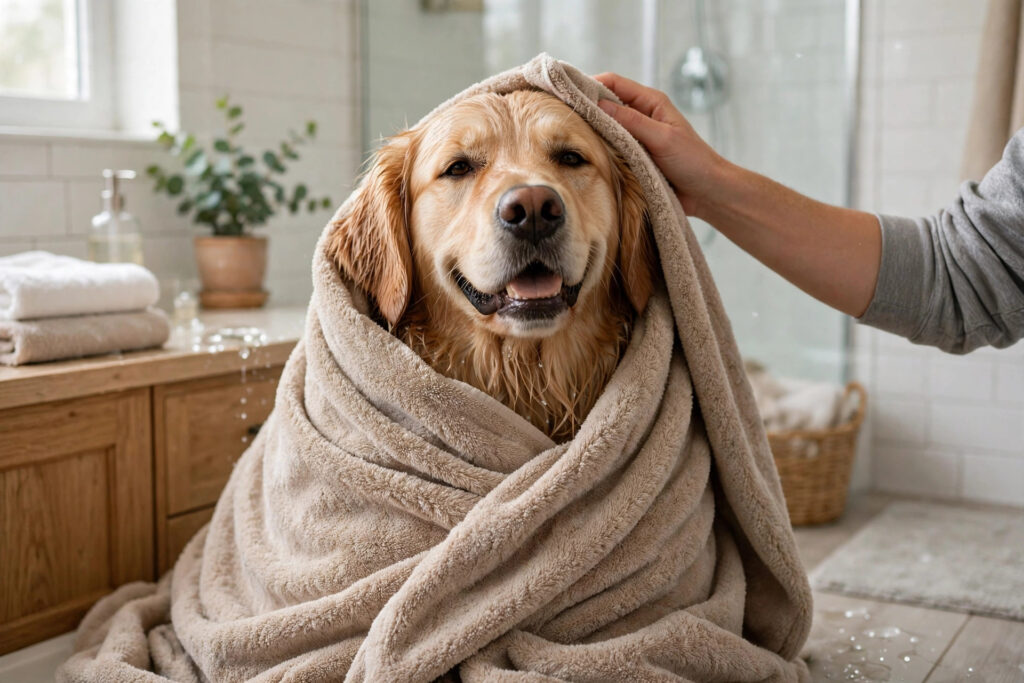
Sensitive skin, in practice, means a dog whose skin reacts to things other dogs tolerate: itching after a bath, redness or flaking after a new product, dryness that returns within days. That reaction has many causes, including dry skin, irritation from a fragrance or soap, an allergy, parasites, and bacterial or yeast infection. A wash cannot tell them apart. That sets the limit of everything in this guide: a homemade wash can clean a coat gently and support comfort, but it cannot diagnose a cause or treat a condition.
Search results also disagree wildly. One diy dog shampoo recipe uses a cup of dish soap. Another uses a cup of vinegar. A third adds essential oils to a “sensitive skin” recipe. A fourth warns against all three. They cannot all be right, and for a sensitive-skinned dog, following the wrong one is an irritated dog. Why do dog shampoo recipes disagree like this? Most are written for an average, healthy dog, not a reactive one. This guide picks the most conservative option each time and says why.
“Natural” is never used here as a reason something is safe. Poison ivy is natural. Tea tree oil is natural. Neither belongs on a sensitive dog.
A Gentle Wash vs a Medical Skin Problem
Itching is a sign, not a diagnosis. Veterinary guidance lists the common causes as flea allergy dermatitis and other allergic skin disease, food allergy, contact dermatitis (including from soaps and perfumes) and sarcoptic mange. Itching can lead to red, inflamed skin, infection, hair loss, scabs and raw skin from scratching. Diagnosis may need skin scrapings and tests for mites, bacteria and yeast, and many cases can be controlled but not cured.
So if your dog’s itch has a medical cause, no wash, homemade or shop-bought, treats it. The wash manages the coat while the vet manages the cause.
What a gentle wash can do: remove surface dirt, pollen and allergens, support comfort for mild dryness, and keep a healthy coat clean without fragrance, dye or harsh detergent.
What it cannot do: diagnose or treat dermatitis, infection, allergy, parasites or yeast, replace a medicated shampoo prescribed by a vet, or fix an ear infection or hot spot. Oatmeal is widely described as soothing, and a vet-reviewed source says colloidal oatmeal supports skin comfort but does not identify or remove the underlying cause of itching. Soothing is not treating.
Why Dog-Specific Products Matter
Dog skin is not small human skin. The American Kennel Club (AKC) gives human skin a normal pH of 5.5 to 5.6 (acidic) and dog skin 6.2 to 7.4 (more neutral). Skin has a thin protective layer called the acid mantle, which guards against germs and keeps skin hydrated, and bathing washes it away. A human shampoo disrupts it, which can leave a dog’s skin dry, flaky and open to irritation. Dogs also have only 3 to 5 layers of skin cells against 10 to 15 in humans, so the barrier is thinner to begin with.
The AKC adds a useful nuance: a once-in-a-blue-moon emergency wash with human shampoo will likely be fine, but it is not a routine. That is the honest position: no panic about one accidental wash, and no permission to make human shampoo the habit.
There is an inconsistency worth knowing about. The AKC’s human-shampoo article advises against it, yet its own homemade shampoo page uses baby shampoo, dish soap, vinegar and even lavender oil in some recipes. For sensitive skin, follow the safety guidance, not the recipe page.
A kitchen mix also has a problem no ingredient list solves: it cannot guarantee pH, concentration or preservation. That is why the default for most owners should be a commercial dog shampoo made for sensitive skin, fragrance-free, with a stated pH. A homemade wash is the exception, for owners who understand the limits. If you want a rough home check, a vet quoted by Care.com says a pH of 6.5 to 7.5 is generally considered safe for most dogs. A test strip is only a rough check, not proof a mix is right for your dog.
Ingredients to Avoid in DIY Dog Shampoo
If an ingredient is on this table, it does not go in a sensitive-skin wash, whatever a recipe title promises.
| Ingredient | Why it is out |
|---|---|
| Tea tree oil | The ASPCA advises completely avoiding direct application of concentrated essential oils to pets, and notes concentrated tea tree oil may cause problems with only seven or eight drops. If exposure is suspected, call a vet or ASPCA Animal Poison Control at (888) 426-4435 immediately. |
| Other essential oils (eucalyptus, peppermint, citrus, pine, wintergreen, pennyroyal, cinnamon, clove) | Flagged by veterinary sources as toxic or irritating to dogs. See our guide on whether essential oils are safe for dogs. |
| Lavender and chamomile oils | Some recipes, including one on the AKC’s site, add a couple of drops of lavender oil. The ASPCA’s advice is to avoid applying concentrated oils at all. For sensitive skin, scent is not worth the risk. |
| Human and baby shampoo | Wrong pH for dog skin. Fine once in an emergency, not as a routine. |
| Dish soap | The AKC notes frequent use may be drying, especially for sensitive skin. Keep it for a one-off emergency such as heavy grease, not as a regular wash. |
| Vinegar and lemon juice | Vet-reviewed sources say vinegar should only go on skin very diluted and only if your vet recommends it, and even dilute vinegar can irritate some dogs. Never use it on broken skin. |
| Bleach, ammonia, alcohol, artificial fragrance and dyes | Known irritants. Never mix bleach with vinegar or ammonia, which makes toxic gases. |
| Honey, chamomile tea, vitamin E | Often claimed to be antibacterial or to preserve a mix, but we found no reliable veterinary support. Vitamin E does not preserve a homemade wash. |
If there is a strong odour, greasiness or a possible yeast infection, see a vet before using any wash.
Dog Shampoo Recipes for Sensitive Skin: Two Gentle Frameworks
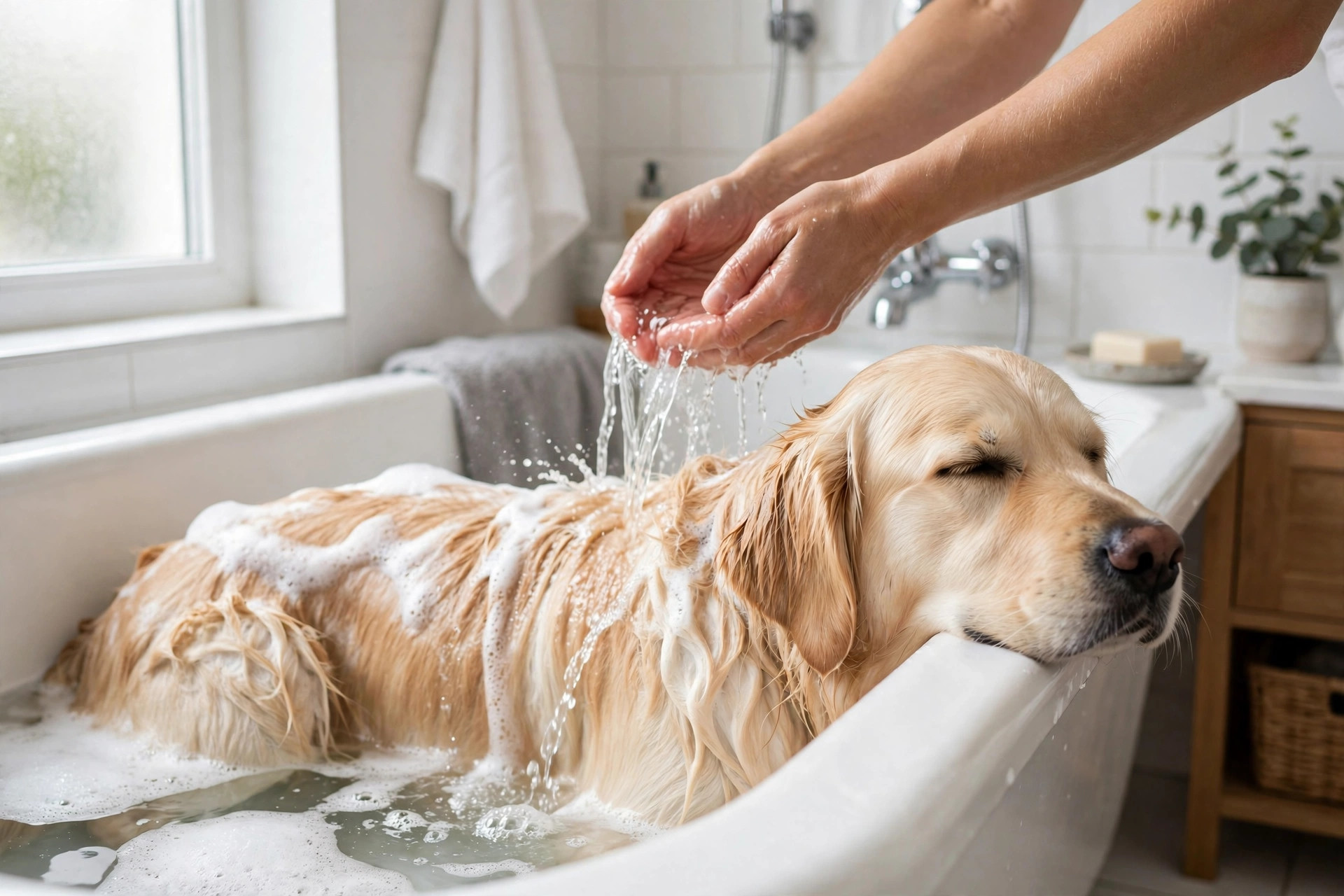
Most dog shampoo recipes online are written for healthy skin. These two are the most conservative options for a reactive coat. Neither is a treatment, and neither has been tested on your dog by a vet. Use them only on unbroken skin, after a patch test, and skip them completely if any red flag below applies.
Recipe A: Oatmeal wash (the gentlest, start here)
This is based on the oatmeal recipe the AKC publishes.
- 1 cup plain uncooked oatmeal
- 1/2 cup baking soda
- 1 quart (4 cups) warm water
Grind the oatmeal in a coffee grinder or food processor until it is as fine as flour. Mix it with the baking soda in a bowl, add the warm water and stir. Make it fresh for each bath. Finely ground oats spread across the coat far better than whole flakes, which tend not to distribute or rinse cleanly.
Recipe B: Diluted unscented castile wash (for a dog that needs real cleaning)
- 5 tablespoons unscented liquid castile soap
- 3 cups lukewarm water
This is the same ratio as one published recipe, without its coconut oil, rosemary or essential oils. Use unscented soap only, because scented types add fragrance and essential-oil risk. Be aware that a vet quoted by Care.com puts castile soap at around pH 8.9, which is very alkaline and can strip a dog’s natural oils. If your dog has very sensitive skin, Recipe A or Recipe C is usually the better choice, and if a test strip reads well above 7.5, do not use the mix.
Recipe C: Plain lukewarm-water rinse (no recipe, no residue)
Use it between baths, for a muddy dog that does not need shampoo, and while you wait for a vet appointment. It is also the safest answer when you are out of dog shampoo. No ingredients means no reaction to manage.
How to Make Homemade Dog Shampoo Step by Step
- Check the skin first. The skin must be unbroken, with none of the red flags below. If not, call your vet instead.
- Patch test. Put a small amount of the wash on one small area, such as behind the ear or the inner thigh. Rinse after a minute and watch for 24 hours for redness, swelling or itching. A patch test only shows whether your dog reacts. It does not prove the mix is safe or clean.
- Make a fresh batch. Mix it just before the bath and throw away whatever is left. A homemade mix has no preservative, so never keep it in a warm bathroom.
- Brush, then wet thoroughly. Brush out tangles first, because water tightens mats. Wet the whole coat with lukewarm water, never hot, which dries and irritates sensitive skin.
- Work the wash in gently. Use flat hands and slow strokes in the direction of the coat, right down to the skin, and keep it out of the eyes and ears.
- Leave it on briefly. A few minutes is plenty if your dog tolerates it. If your dog is stressed, rinse sooner.
- Rinse for much longer than you lathered. The AKC stresses that the rinse is the most important part of the bath. Keep rinsing until the water runs clear, then rinse once more. For double coats, rinse in sections, because a clean-feeling top coat does not mean a clean undercoat.
- Towel-dry, then check the skin. Look for redness or flaking, and watch your dog for the next 24 to 48 hours.
Residue is the most common reason a bath makes things worse. A dull coat, flaking, or itching that returns within a day or two are residue signs. Re-rinse with plain lukewarm water.
How often? There is no single schedule. The AKC says it depends on breed, coat, activity and skin health, and that most dogs need only occasional baths unless a vet advises otherwise. Never bathe daily to chase an itch, because over-bathing strips natural oils and leaves skin drier and itchier.
When Homemade Dog Shampoo Is the Wrong Choice
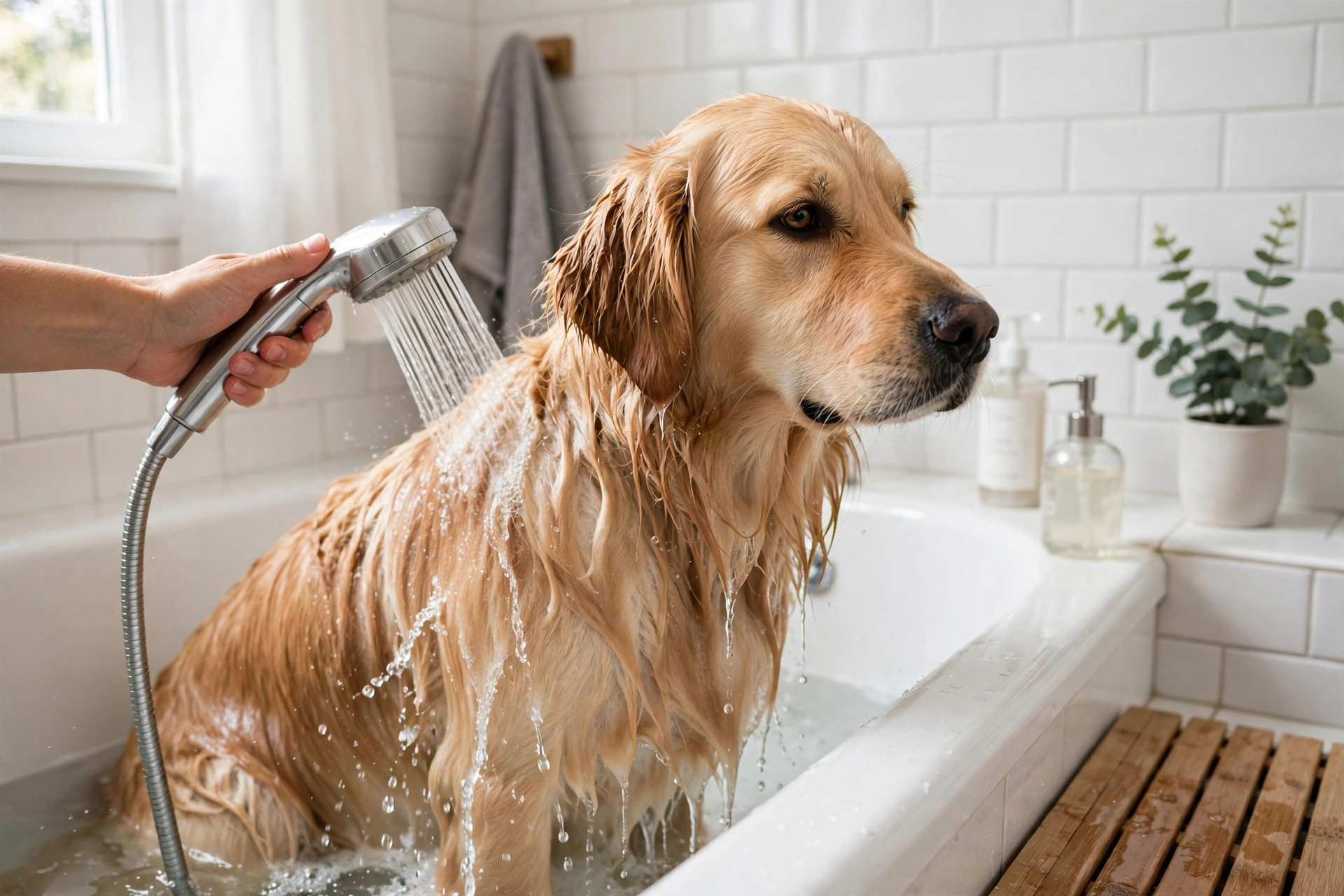
Put the bottle down and call a vet if any of these apply. This is a “do not wash, call” list, not a “try it and see” list.
- Broken, raw, bleeding or oozing skin, open wounds, or hot spots (red, raw, moist patches, often smelly).
- Hair loss or bald patches, spreading redness, pus, crusts or a strong odour.
- Ear infection signs: head shaking, ear odour, discharge or ear scratching. An ear infection needs medication, not shampoo.
- Itching that stops your dog sleeping, lasts more than a few days, or returns quickly after a bath.
- Vomiting, diarrhoea, lethargy, fever or appetite change alongside skin signs.
- A suspected yeast infection (odour, greasiness, a yeasty smell).
- Fleas. A homemade wash is not flea prevention.
- A medicated shampoo prescribed by your vet. A homemade wash must never replace it.
- Puppies, seniors, pregnant dogs, hairless breeds, or dogs with open sores: ask your vet first.
If Itching Gets Worse After a Bath
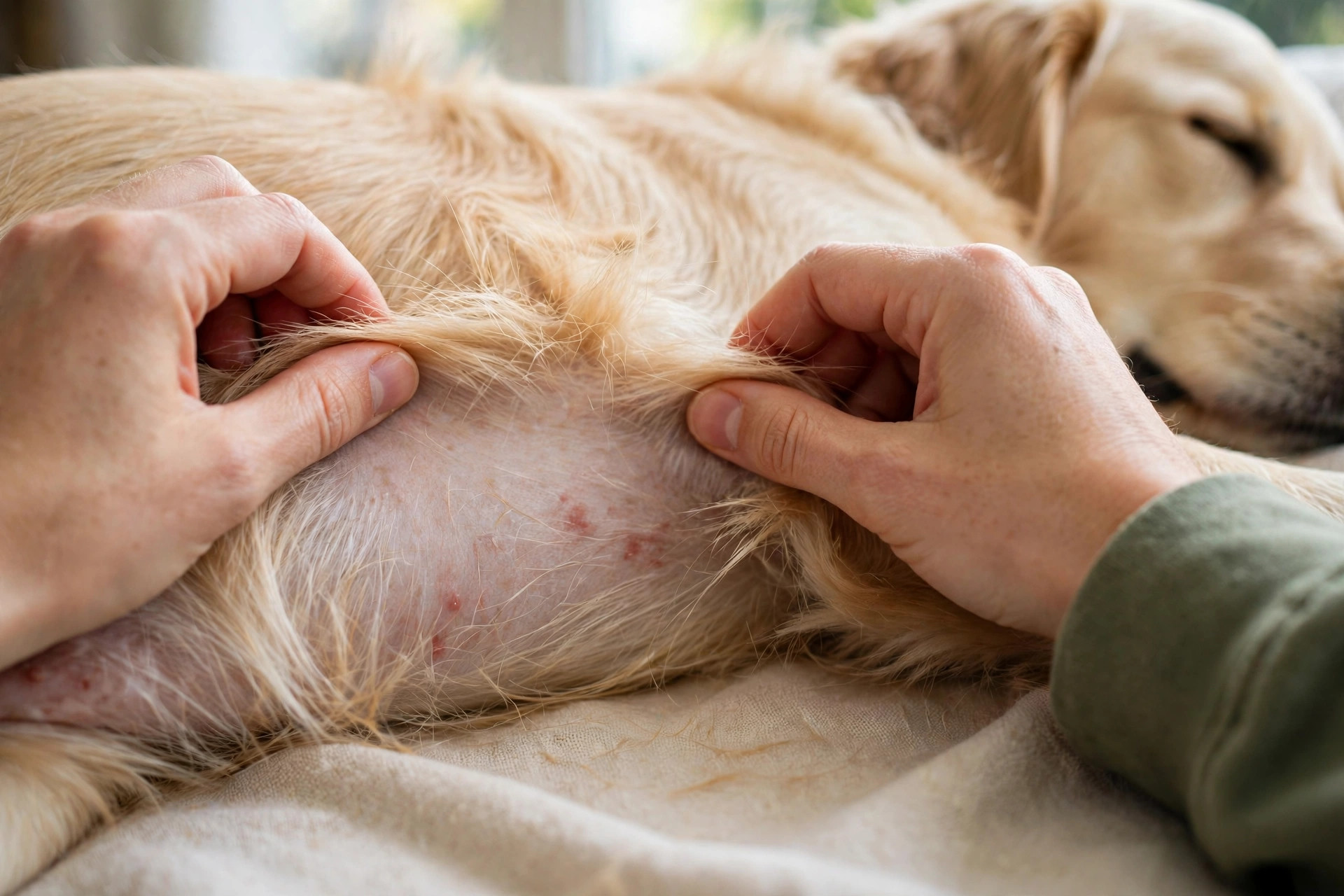
Do not panic, and do not reach for a stronger product. A reaction after a bath usually means residue left in the coat, sensitivity to an ingredient, or an underlying condition the bath has revealed.
- Stop the product. Do not reapply it, wash it out with a different shampoo, or add oils, creams or human products.
- Re-rinse with plain lukewarm water until the water runs clear, in sections for a thick coat.
- Note what was used. Ingredients, amounts and contact time are more useful to a vet than a description of the itch.
- Call your vet if the rash is widespread, painful or worsening, or does not improve by the next morning. Same-day care is needed for raw or bleeding skin, rapidly spreading patches, a dog who cannot rest, or a dog who is unwell, off food or has a fever.
While you wait, avoid tea tree oil, essential oils and human creams.
Before trying an unfamiliar shampoo on sensitive skin, I check the manufacturer’s directions and ask the veterinarian whether that dog needs an individualized test. I would not use a homemade mixture with unknown dilution or storage stability. If irritation appears, I stop the product and contact the veterinary clinic rather than relying on a patch test to guarantee safety.
Sarah lauren
Frequently Asked Questions
Conclusion
Homemade dog shampoo for sensitive skin works when it is kept small, gentle and honest: one oatmeal wash or one diluted unscented castile wash, patch-tested first, rinsed until the water runs clear, made fresh each time and used only on unbroken skin.
It does not treat anything, it does not earn the word “safe” from the word “natural”, and it stops the moment a red flag appears. The best dog shampoo recipes for sensitive skin are the plainest ones. Keep diy dog shampoo that narrow, and it is a genuinely useful tool. Stretch it further, and it becomes the irritation you were trying to wash away.
References
- AKC, “Can You Use Human Shampoo on Dogs?”: https://www.akc.org/expert-advice/health/human-shampoo-on-dogs/
- AKC, “How to Make Homemade Dog Shampoo”: https://www.akc.org/expert-advice/health/easy-natural-homemade-dog-shampoo/
- AKC, “Dog Grooming at Home: Brushing, Bathing, and Nail Care”: https://www.akc.org/expert-advice/health/how-to-groom-a-dog/
- ASPCA, “The Essentials of Essential Oils Around Pets”: https://www.aspca.org/news/essentials-essential-oils-around-pets
- VCA Animal Hospitals, “Pruritus (Itching and Scratching) in Dogs”: https://vcahospitals.com/know-your-pet/pruritus-itching-and-scratching-in-dogs
- WebVet, “Oatmeal Shampoo for Dogs”: https://www.webvet.com/oatmeal-shampoo-for-dogs/
- Care.com, “Homemade Dog Shampoo: A Natural and Affordable Option”: https://www.care.com/c/homemade-dog-shampoo-recipes/