Why does my makeup separate on my nose when my cheeks look perfect?
Your sponge did everything right on your cheeks, then failed on your nose. The same foundation, the same morning, the same face, yet by lunch the base around your nose has split into patches, dotted into pores, or gathered in the folds beside your nostrils.
That is makeup separating on nose at its most familiar. It means the nose was treated like the rest of the face, when it behaves nothing like it. This guide treats it as its own zone, with a fix for each cause.
Why Does My Makeup Separate on My Nose?
Your makeup separates on your nose because the nose is oilier, more creased and touched more often than the rest of your face, so a thick, wet or clashing base breaks up there first. Makeup separating on nose is usually a zone problem, not a foundation problem. It needs its own routine: a settled, thin base, very little foundation, product pressed in rather than brushed on, and powder only where oil actually breaks through. Fix the zone and the rest of your base can stay exactly as it is.
Why Does My Makeup Separate on My Nose? The Nose Is a Problem Zone
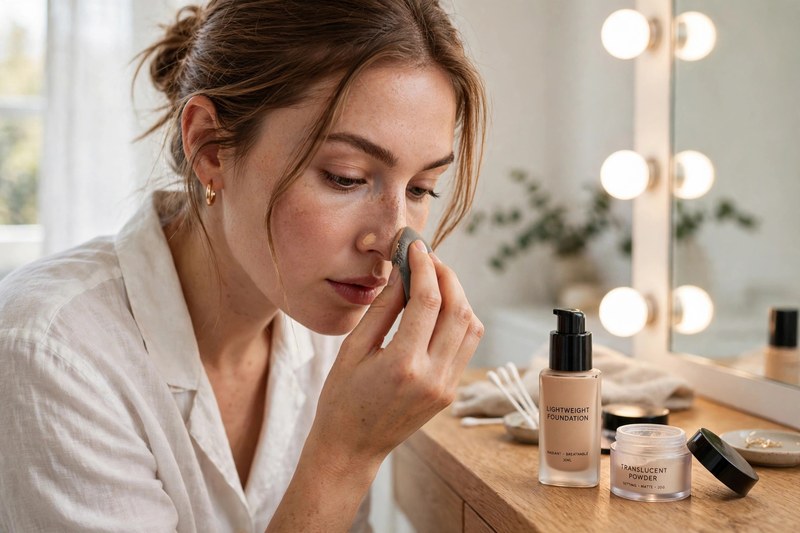
The nose fails first because several problems land on one small area at once. Research measuring facial sebum has found higher levels on the forehead, nose and chin than on the cheeks, with the highest levels in summer, and one study found the nose had the most sebum of the five facial areas tested. If you keep asking why is my makeup separating on my nose, the answer is almost always several small causes at once, not one bad product.
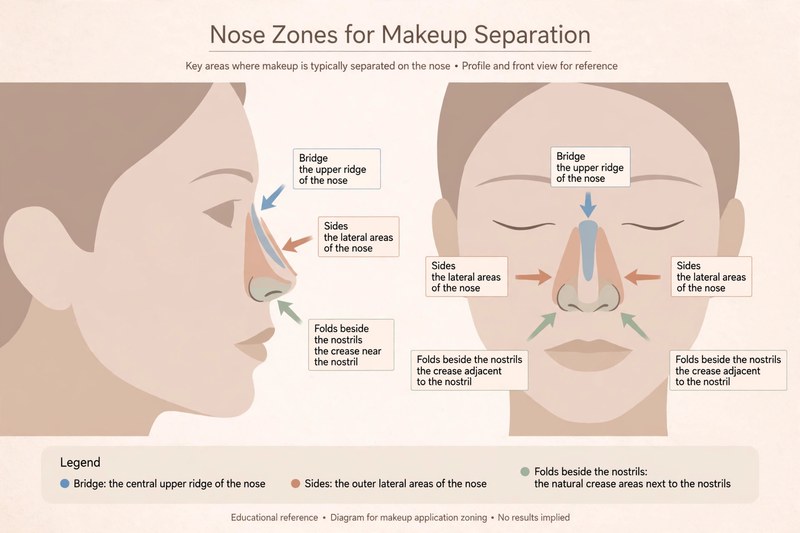
Foundation separates on nose first because oil is only the start. The nose is also curved and creased, so product collects in the folds beside the nostrils and dots into visible pores. It moves every time you smile or talk. And it is touched more than any other part of the face, by glasses, tissues and fingers.
That combination is why a base can look perfect everywhere else and still break up here. The cheeks are flatter, drier and left alone, while the nose is oilier, more creased and touched more often. So the fix is not a stronger foundation. It is a lighter, more deliberate routine for this one zone, while the rest of your makeup stays unchanged.
Oil, Texture and Friction
Three forces do most of the damage, and they usually work together.
- Oil. As it rises through the day, it softens the foundation film from underneath, so the base slides, thins and eventually splits. Warm weather speeds this up, which is why the problem often looks worse in summer.
- Texture. Pores, fine lines around the nostrils and flaky patches give foundation an uneven surface. Product pools in the low points and wears off the high points, so the nose looks dotted and patchy while the cheeks stay smooth. Dry skin around the nostrils can cause the same patchy look as oily skin, which is why “just mattify it” fails for some people. A flaky nose needs moisture, not more powder.
- Friction. The most underestimated force. Every time you blow your nose, push your glasses up or rest a hand near your face, you move a base that was barely holding on. A thick layer breaks under friction faster than a thin one, because there is more product to shift. That is why this guide keeps coming back to the same idea: less product, pressed in, on a settled base.
Why Is My Makeup Separating on My Nose? Start With the Pattern
Foundation separating on nose can come from oil, dry flakes, friction or product layering. Work out which pattern you are seeing before you change anything, because different patterns need different fixes, and the wrong one (powder on a flaky nose, for example) makes it worse.
| What you see | Likely cause | Fix first |
|---|---|---|
| Makeup breaks up after a few hours and the nose looks shiny | Oil breaking through | Thin layers, mattifying primer only on the nose, blot during the day |
| Makeup clings to flakes around the nostrils | Dry, flaky skin | Gentle moisture on the flaky edges, less powder, no harsh scrubbing |
| Makeup pills or patches within minutes of applying | Product clash or a wet base | Let each layer settle, then drop one product at a time to find the clash |
| Makeup settles into tiny dots on the nose | Visible pores and texture | Press a pore-filling primer into the pores, then a thin foundation layer |
| Bare patches on the bridge of the nose | Glasses or mask friction | Less product where frames sit, light powder, clean nose pads |
How to Fix Makeup Separating on Nose: Step by Step
Work through these in order and change one thing at a time. Stop when the problem clears.
Prep the Nose Separately
Do not prep the nose as an afterthought. Give it its own short sequence, after your normal skincare, and keep the layers thin.
Start with a clean, comfortable surface. If the nose feels oily, a gentle cleanse is worth it. If the nostril edges are flaky, do not scrub them, because scrubbing usually leaves raw patches that grab foundation even more unevenly. Then apply a thin layer of lightweight moisturiser only where the nose actually feels tight, often just the nostril edges. Even an oily nose can feel tight and look flaky by midday if you skip moisture entirely.
Then let everything settle, which is the step most people rush. Sunscreen and moisturiser that are still wet or tacky give foundation a moving surface, and the base separates within minutes rather than hours. Wait until the surface no longer feels wet. Getting dressed or brushing your teeth between skincare and makeup builds that pause in without extra waiting.
Use Less Foundation
The nose does not need a fresh pump, a full brush-load or a second layer for coverage. It needs whatever is left over after the rest of your face is done.
Apply foundation to your cheeks and forehead first. Then press whatever product remains on the sponge or brush over the nose. If redness still shows through, add a tiny amount of concealer placed exactly on the red spot, not another layer of foundation over the whole nose. Redness is the reason many people overload the nose, and overloading is what makes the base break up.
The same rule applies to every other layer. Concealer, powder and contour all count toward the total thickness on the nose, and five reasonable layers add up to a thick film that cannot flex with the skin. If your nose base looks heavy before you leave the house, it will look worse by lunch. Thin it now, while it is still easy to fix.
Press Product In
How you apply foundation matters as much as how much you apply. Rubbing and dragging can lift the primer underneath and push foundation into creases where it collects. On the nose, that dragging is often what starts the separation.
Use a damp sponge or a small, dense brush, and press or bounce the product in with short tapping motions. Press around the nostrils and into the folds beside them rather than sweeping across them, and use the clean side of the sponge to lift away excess before you set anything. If the base looks thick before powder, it is already too thick, so press again and remove product instead of adding more.
The same rule applies to every step that follows: press primer in, press powder in, press a touch-up in. Rubbing is the motion that breaks a nose base, during application or hours later.
Primer: When It Helps or Hurts
Primer is useful on the nose, but only in the right place, in the right amount, and with the right partner. A thin layer of a mattifying or pore-filling primer, pressed into the nose and inner cheeks only, gives foundation something to grip and softens the look of pores. Follow the product label for the amount. A thick cushion of primer slides just as badly as a thick layer of foundation.
Primer hurts when it fights the foundation. A hydrating, slippery primer on an already oily nose can trap oil underneath the base. Whether two products work together depends on the exact formulas, not just labels such as “water-based” or “silicone-based”. If your makeup separates within minutes of applying it, suspect a clash before you blame the foundation. Test it simply: wear the foundation for a few days without primer and keep every other step the same. If the problem improves, the primer was part of it.
Primer also hurts on a dry, flaky nose, because a mattifying primer over flakes makes them more obvious, not less. On flaky nostril edges, skip primer and use a little extra moisture instead. Our moisturizer vs primer guide compares the two orders directly.
Powder the Nose Strategically
Powder is a finishing tool for the nose, not a blanket. Press a small amount of translucent powder into the places where oil actually breaks through (the sides of the nose, the folds beside the nostrils, and the bridge if it gets shiny) using a small brush or the edge of a puff. Press, do not sweep, because sweeping moves the foundation you just placed.
Timing matters too. Powder before the shine starts, while the base is still intact, rather than after it has broken up. Powder laid over broken makeup locks the break in place and looks cakey. Use less than you think. Powder should be a veil you cannot see, not a visible layer. If the nose looks dusty or dry after powder, you used too much. The fix is a light mist of setting spray or a press with a damp sponge, not more product.
Skip heavy powder, including baking, on a dry or flaky nose, because powder over flakes highlights every one of them. On that nose, set with the lightest possible press, or skip powder on the flaky patches and set only the oily bridge.
Check Your Foundation Formula Last
Change the formula only after you have fixed prep, amount, pressing, primer and powder. Very emollient, creamy or dewy foundations often slide on an oily nose, and very matte, heavy formulas can cling to dry flakes. If the problem remains after everything above, try a formula that suits the skin on your nose rather than the rest of your face, and test it for a few days before judging.
Glasses, Tissues and Touching
Some nose separation is mechanical, and no product fixes friction on its own. Glasses are the biggest culprit: nose pads sit on the bridge, shift slightly all day and rub a neat bare patch into the foundation. Tissues do the same more aggressively, especially during a cold, when the nose is blown repeatedly and the skin underneath is already irritated.
- Reduce the product where frames sit. Apply less foundation on the bridge, and set that strip a little more firmly with powder.
- Clean the nose pads regularly. Oil and dirt on the pads transfer straight onto the base.
- Check the fit. If your frames constantly slide, a fit adjustment does more for your base than another layer of setting spray.
- Blot tissues, do not rub. Accept that a blown nose will disturb the base. The repair section below handles that in under a minute.
- Keep hands off your nose. Most face-touching is unconscious, and every touch is a small rub on the weakest part of the base.
Midday Repair
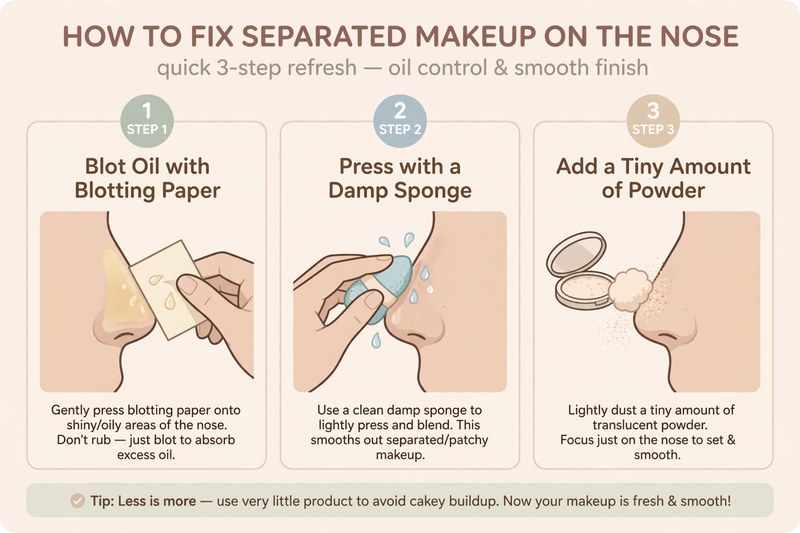
When the base has already broken up, do not add more foundation over it. That is the instinct, and it is what makes the patch look worse. New product floats on oil and broken film, then breaks up again within the hour. When foundation separates on nose, work in this order:
- Blot. Press a blotting paper or a folded tissue gently onto the shiny or broken area, without rubbing.
- Press. Use a clean, dry sponge or a fingertip to press the separated makeup back into a smooth layer. If you want to use a damp sponge, test it on a small area first.
- Add only what is missing. A tiny amount of powder, or a dot of foundation tapped on exactly where coverage has gone, and nowhere else.
- Leave it alone and let it settle.
If the whole nose has gone, rebuild just the nose. Remove the broken base from that zone only, press on a thin layer of leftover foundation, set lightly and move on. Rebuilding one small zone takes less time than layering over the damage all day.
If your base also pills elsewhere, our makeup pilling troubleshooting guide covers each pattern. It is a useful second check when makeup separating on nose is part of a wider pilling problem.
What Not to Put on Your Nose
A few common habits make nose separation worse, and each has a simple replacement.
- A thick layer of foundation to cover redness. Use a dot of concealer on the red spot instead, and keep the surrounding base thin.
- Mattifying primer over dry, flaky nostril edges. Moisturise those edges and skip primer there.
- Heavy or baked powder on a nose that already looks dry or textured. Set lightly, or set only the oily parts.
- A new, untested product on an important day. A new primer, foundation or sunscreen belongs in a low-stakes test first, because a clash shows up on the nose before anywhere else.
- Setting spray as a rescue for a base that has already broken up. It locks in whatever is underneath, including a broken layer, so repair first, then set.
- Extra layers through the day to chase the problem. Each added layer is another film that can split. Blot, press, add a dot where coverage is missing, and stop.
For an oily nose that breaks up all over the T-zone, not just the nose, our oily-skin prep guide treats the whole zone.
Frequently Asked Questions
Conclusion
Makeup separating on nose is a zone problem with a zone solution: prep the nose separately, let each layer settle, use only leftover foundation, press everything in, prime and powder only where they earn their place, and repair midday by blotting and pressing instead of adding layers.
Change one thing at a time, starting with the amount of foundation on the nose, and give it a few days before judging the result. If the problem is wider than the nose, with foundation breaking up across the whole face, our foundation separating guide takes the same fixes further.
References
- PubMed, “Regional and seasonal variations in facial sebum secretions: a proposal for the definition of combination skin type”: https://pubmed.ncbi.nlm.nih.gov/15998330/
- PubMed Central, facial sebum excretion measurement study: https://pmc.ncbi.nlm.nih.gov/articles/PMC10483949/
- Live Science, “Why is the ‘T-zone’ on your face so oily?”: https://www.livescience.com/health/why-is-the-t-zone-on-your-face-so-oily