Do you really need all of that before your foundation, or are you just making your makeup slide off? If you have ever stood in front of the mirror with five bottles open and no idea which one goes first, you are asking the right question. Skincare before makeup is not about using more products. It is about putting the few you use in an order that lets each one settle, so your base has something smooth and steady to sit on.
✓
Quick Answer
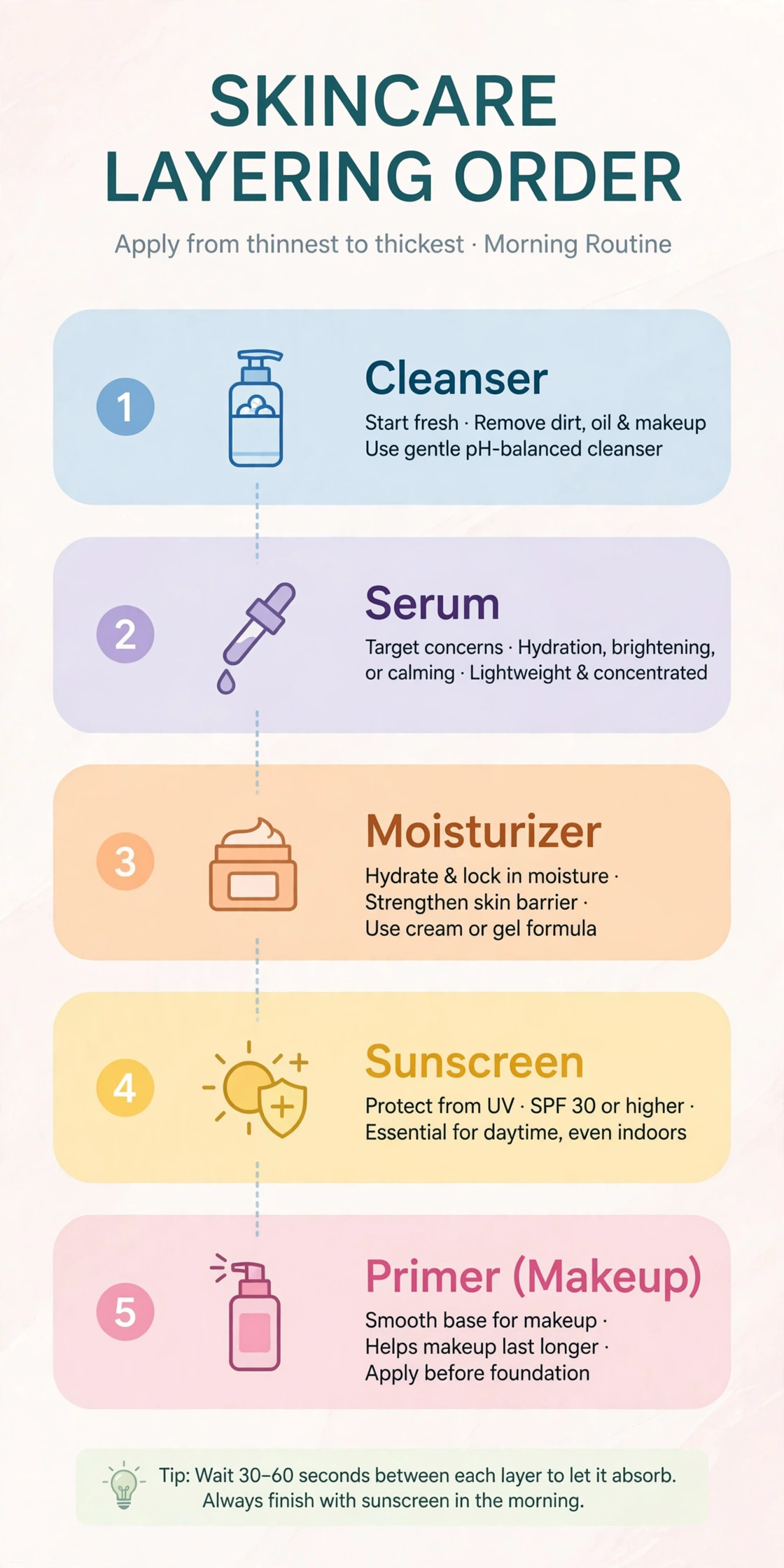
The usual order is: cleanser (only if needed), toner (optional), serum, moisturizer, sunscreen, then primer and makeup. Apply products from thinnest to thickest and let each layer settle before the next.
Sunscreen is the last skincare step, and primer is the first makeup step, not the last skincare step. The American Academy of Dermatology (AAD) advises applying sunscreen to dry skin about 15 minutes before going outdoors.
Skincare Before Makeup: The Minimum Steps You Need
Most makeup days need only three or four steps: a gentle cleanse if your skin needs it, one serum if you use one, a moisturizer matched to your skin, and sunscreen in the daytime. That beats a seven-step routine rushed in four minutes.
Every product you add is another layer your foundation has to sit on. When layers are wet, thick or rubbed together, they mix instead of stacking. That is when you get rolling, patchiness, and a base that looks fine at 8 a.m. and uneven by lunch. Fewer layers, applied thinly and given a moment to settle, give a far more predictable result.
If you use prescription skincare, follow your clinician’s instructions first. This article covers the layering order and which steps you can drop, not foundation application itself.
Cleanser: When You Need It
You do not always need a full morning cleanse. If you washed your face the night before and your skin feels comfortable, a splash of lukewarm water may be enough. The point of a morning cleanse is to remove overnight oil, sweat or leftover night products, not to strip your skin bare.
Cleanse properly when there is a reason to: overnight oil or sweat, leftover makeup or sunscreen, or a heavy night cream still on the surface. Use a gentle cleanser, lukewarm water and your fingertips, then pat dry and move on while your skin is still slightly damp.
Skip harsh products on a makeup morning. A strong scrub or a new exfoliant can leave flakes or uneven texture that no blending will hide, so save experiments for a no-makeup day. And wash your hands first.
Toner Before Makeup: Do You Need It?
Many people search “what is toner makeup” and picture a makeup product. Toner is actually a skincare step. Cleveland Clinic describes it as a water-based lotion or tonic used after cleansing and before moisturizing. You swipe or spray it over your face, and you do not wash it off.
Toner is optional. Plenty of dermatologists say most people can skip it, because their cleanser and moisturizer already do the job. If you do use one, it goes after cleansing and before your serum. Dermatologists often advise people with acne, rosacea or sensitive skin to be careful with toners, because some can irritate, so check with your dermatologist if your skin is reactive.
On a makeup morning, keep toner light and familiar, and let it settle before the next layer.
Serums: Which Ones Belong in the Morning
Morning serums should be light, familiar and few. One serum is enough for many people. If you already use two, keep the wateriest one for the morning and save the heavier one for the evening. The morning is not the time to introduce a demanding new active right before you need your makeup to behave.
The best morning choices are usually the simplest: a hydrating serum with hyaluronic acid or glycerin on damp skin, or a vitamin C serum if it is already part of your routine and your skin tolerates it well. Press a few drops gently over the face, then wait about 60 seconds, or until it no longer feels tacky, before the next step.
A serum goes before moisturizer, not after, because lighter, thinner products go on first. Cleveland Clinic advises ordering skincare from lightest to heaviest (thinnest to thickest).
What does not belong on a rushed morning? Anything new, anything strong your skin has not settled with yet, and multiple serums stacked together. Each extra film is another chance for pilling, so test new products on a quiet morning first.
Moisturizer: Match the Texture to Your Skin
Moisturizer is the step many people get wrong in both directions: too much, or skipped entirely. Even oily skin usually needs some light moisture. Dry or dehydrated skin can make foundation look uneven and emphasize texture, which is why a base can look smooth at first and then tight or patchy an hour later. But a thick layer that is still slippery when you reach for sunscreen will slide everything that follows.
Match the texture to your skin. A lightweight gel or lotion usually suits oily or combination skin, and a richer cream suits dry skin. Use enough that tightness disappears, and no more. Press it in gently and wait until it feels set, with no pooling and no slip, before you apply sunscreen. To check, lightly touch a clean fingertip to your cheek. If the product is still wet or moving, wait a little longer. If only one area feels tight, add a tiny extra amount just there.
Sunscreen: The Last Skincare Step
Sunscreen is last among skincare, even if it is tempting to treat primer as an extra skin step. It needs to form an even film, and nothing should disturb that film before makeup. Spread it in a thin, even layer over moisturizer.
How Much Sunscreen to Use
The AAD recommends a broad-spectrum, water-resistant sunscreen with SPF 30 or higher. For your face, the AAD says to use at least 1 teaspoon, which is about the amount needed to cover the length of your index and middle fingers. Using too little is the common mistake, so do not thin it out to stop pilling. Change the formula or the layers underneath instead.
A makeup product with SPF does not replace a dedicated sunscreen layer unless you apply it at the same generous amount, which few people do. The AAD notes that SPF cosmetics are convenient, but sunscreen still needs to be reapplied about every two hours when you are outdoors.
How Long to Wait Before Makeup
Two different timings apply here, and they are easy to mix up:
For sun protection: the AAD says to apply sunscreen to dry skin about 15 minutes before going outdoors.
For your makeup: wait until the sunscreen no longer feels wet or tacky. Many guides suggest about 2 to 5 minutes, depending on the formula, and your product label may say otherwise.
You can finish your makeup within the 15 minutes, as long as the sunscreen has set before you start. If you need to move faster, shorten the other steps, not this one.
Which Sunscreen Texture Works Under Makeup
Choose a texture you actually like under makeup. If your sunscreen pills or leaves skin greasy, a different formula often solves the problem better than adding more products. The AAD notes that creams suit dry skin and the face, gels suit oily complexions, and mineral sunscreens (with zinc oxide or titanium dioxide) are recommended for sensitive skin. A tinted sunscreen can also help you avoid a white cast.
Primer Is Makeup, Not Skincare
Primer sits at the start of makeup, not the end of skincare. It goes on only after your sunscreen has set. If it goes on over still-wet sunscreen, the two mix and the primer cannot grip.
Do you even need primer? Not always. If your skin is balanced and your foundation wears well without it, you can skip it. Primer is useful when you have a specific problem to fix, such as visible shine, a patch of roughness or a base that fades quickly. Choose a type for the job: hydrating for dry areas, mattifying for oily zones, and a smoothing type where texture is the main issue.
Apply primer thinly and only where you need it, then let it settle for about a minute before foundation. A thick primer layer is just another chance for rolling.
How to Layer Skincare Before Makeup Without Pilling
Pilling is the little balling or flaking that happens when products roll up on the skin. It happens when a fresh, wet layer is rubbed over a layer that has not set yet, or when too many films are stacked without waiting.
The fix is mostly about touch and timing, not buying another product:
Press, do not rub. Press each layer in instead of rubbing it in circles.
Wait until each layer feels set. That is usually about 30 to 60 seconds for light products and 2 to 5 minutes for sunscreen.
Use less than you think you need, apart from sunscreen, which stays at the full amount.
Work one product at a time. Finish a layer before you start the next.
If a combination still pills, try dropping one product, swapping the order of only one step, or giving the earlier layer a longer pause. Changing everything at once makes it impossible to know what helped.
What to Skip on Rushed Mornings
Skipping a step because you are in a hurry is not the same as skipping skincare carelessly. On a rushed morning, skip new serums, extra masks, heavy creams you do not need, and primer if you are not sure it helps. Keep the steps that protect and smooth: moisturizer, sunscreen, and enough time for the sunscreen to set.
Do not skip sunscreen just because you are busy, and do not skip the pause after it either. If you are short on time, start earlier in the routine. Apply your sunscreen while you choose your clothes, then come back to makeup. Rushing the final step undoes the earlier ones.
Skincare Before Makeup by Skin Type
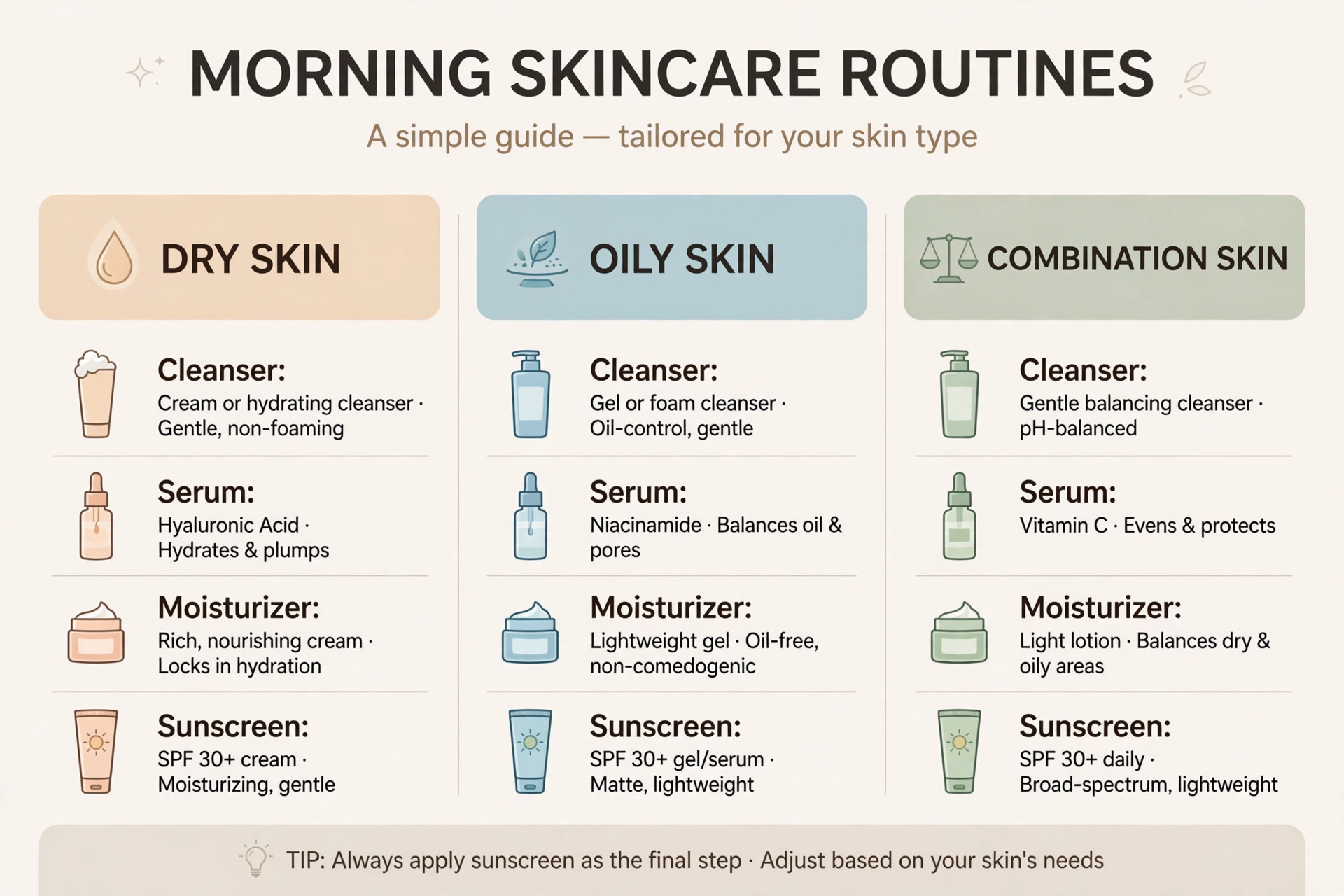
The basic order is the same for every skin type. Only the textures and amounts change.
Oily Skin
Oily skin and makeup can work well together when the base is light and hydrated. Use a gel moisturizer and a gel sunscreen, since gels suit oily complexions.
A mattifying primer on the T-zone only gives oily skin makeup something to grip, and the lightweight makeup oily skin tends to handle best, such as formulas labelled oil-free or non-comedogenic, will last longer on top. Keep every layer thin, because heavy layers are what make a base slide.
Dry Skin
Makeup for dry skin looks best when the base is hydrated, not tight. Use a water rinse or a gentle cleanser, a hydrating serum on damp skin, a richer cream moisturizer, and a cream sunscreen. Add a hydrating primer only where you need it, and give the moisturizer a little longer to settle before sunscreen.
Combination Skin
Treat the zones differently instead of choosing one heavy product for the whole face. A gel moisturizer on the T-zone and a cream on the cheeks, if they need it, works well. Apply sunscreen in an even layer over the full face, then use a mattifying primer on the T-zone and a hydrating one on dry areas.
Sensitive Skin
Keep it simple. Use lukewarm water or a very gentle cleanser, only a familiar calming serum or none at all, a simple fragrance-free moisturizer, and a mineral sunscreen you tolerate well. Skip toner and primer unless they are familiar and your skin handles them. Introduce only one new product at a time.
Quick Routine Table
Skin type
Cleanse
Serum
Moisturizer
Sunscreen
Primer
Dry
Water rinse or gentle cleanser
Hydrating serum on damp skin
Richer cream
Cream sunscreen, full amount
Hydrating, only where needed
Oily
Gentle cleanser
Light hydrating serum or none
Lightweight gel or lotion
Gel sunscreen, full amount
Mattifying on the T-zone only
Combination
Gentle cleanser
Light serum
Gel on the T-zone, cream on cheeks if needed
Even layer, full amount
Mattifying on the T-zone, hydrating on dry areas
Sensitive
Lukewarm water or a very gentle cleanser
Familiar calming serum, or none
Simple, fragrance-free moisturizer
Mineral sunscreen you tolerate well
Only if familiar and tolerated
For the broader picture of preparing skin before any makeup begins, see our skin prep guide.
FAQ
Skincare first, primer second. Cleanse, tone if you use toner, then apply serum, moisturizer and sunscreen in that order. Primer goes on only after that, as the first makeup step. If primer goes on first, the skincare cannot settle evenly underneath it.
Wait until the sunscreen no longer feels wet or tacky. Many guides suggest about 2 to 5 minutes, depending on the formula. The AAD’s 15 minutes is separate: it is how long before going outdoors you should apply sunscreen, so you can finish your makeup within that window. Apply primer after the pause, and foundation after the primer has had about a minute to settle.
Toner is a skincare step, not a makeup product. It is a thin, water-based product used after cleansing and before serum or moisturizer. It is optional, and it can irritate sensitive, acne-prone or rosacea-prone skin, so check with a dermatologist if your skin is reactive.
Yes. Keep the routine light: a gentle cleanse, a gel moisturizer, a gel sunscreen with the full amount, and a mattifying primer on the T-zone only if you need it. Let each layer settle and keep them thin, because heavy layers are what make a base slide.
A gentle cleanser, a light serum or none, a lightweight gel moisturizer and a gel sunscreen. Then choose lightweight makeup oily skin tends to handle well. Keeping the layers thin is what stops oily skin makeup from sliding by midday.
Hydrate first. Use a hydrating serum on damp skin, a richer cream moisturizer and a cream sunscreen, and give each layer a little longer to settle. A hydrating primer only where you need it can help makeup for dry skin look smooth instead of tight.
Sometimes, depending on your skin. If your sunscreen leaves your skin comfortable all morning, you may not need a separate moisturizer. If your skin feels tight, or your foundation looks patchy by midday, add a light moisturizer under your sunscreen instead of skipping it.
Rolling usually means a layer was still wet, too much product was used, or layers were rubbed together instead of pressed in. Wait longer between layers, use thinner amounts (but keep your sunscreen at the full amount), and simplify the routine before changing products.
The order stays the same, but makeup days reward a simpler routine. Use familiar products, lighter textures and longer waits. Save new products, heavier masks and stronger actives for no-makeup days when you can see how your skin reacts.
Conclusion
The right skincare before makeup is simple to remember: cleanse only if needed, toner and serum if you use them, a moisturizer matched to your skin, sunscreen last, and primer only after the sunscreen has set. Give each layer a moment to settle, press rather than rub, and let sunscreen have the longest pause.
That short, steady routine does more for how your makeup looks at the end of the day than any extra product rushed on top of a wet base. For the exact order of the makeup steps that follow, see our makeup order guide.
Hi, I’m Luana, a makeup artist with four years of experience and the owner of Glow Theory Official. I love how a new look or a small change in technique can make you excited about makeup all over again.
Here, I share practical tips, favorite tricks, and inspiration for everything from everyday makeup to bold, creative looks. My goal is to help you feel more confident experimenting and finding what works for you.
Follow Glow Theory Official on social media for makeup tips, beauty trends, and helpful updates. Bring your questions and curiosity. Let’s try something new together!