A shampoo marketed as natural can still be unsuitable for an individual dog; the label and the dog’s response matter more than the marketing term. That gap is the whole problem with choosing the best natural dog shampoo: the word on the front tells you almost nothing about what is inside.
There is no single bottle that wins for every dog. Below: how to read the label, what “natural”, “organic”, “hypoallergenic” and “fragrance-free” actually mean, a shortlist of verified shampoos matched to skin and coat needs, and the checks that stop a bad bottle becoming a skin problem.
Quick Answer
The best natural dog shampoo for your dog is the simplest formula that matches its skin and coat needs. If your dog has reactive skin, choose a formula with veterinary advice and always follow its exact label instructions. A good shampoo should rinse out completely. It is not necessarily the bottle with the longest list of botanical ingredients.
Start by identifying your dog’s skin or coat needs, choose the simplest suitable formula, read the full ingredient label, patch test a small area when appropriate, and rinse thoroughly until the water runs clear.
| Skin or Coat Need | First-Choice Type | Avoid as a First Choice |
|---|---|---|
| Reactive, itchy, or allergy-prone skin | Fragrance-free formula with a short ingredient list, chosen with your vet | Scented formulas, vague “fragrance/parfum”, and tea tree oil |
| Dry, flaky skin | Oatmeal-based soothing formula | Strong clarifying or deodorising washes |
| Healthy, non-reactive coat | A gentle, lightly scented formula if you prefer one | Human shampoo or dish soap as a routine wash |
| Dense double coat | A formula you can work through to the skin, section by section | Heavy butter formulas that leave residue |
| Any skin problem beyond mild dryness | No grooming shampoo: a vet visit first | Medicated shampoo without a vet diagnosis |
Vet Safety Note: Stop and call your vet instead of trying another shampoo if you notice broken, raw, bleeding, or oozing skin, hot spots, hair loss, ear signs, spreading redness, pus, crusts, or a strong smell. Also seek veterinary advice if itching persists, worsens, or keeps returning after bathing. A grooming shampoo provides cosmetic care, not medical treatment.
For the complete grooming foundation that applies across every breed, the complete home dog grooming guide covers tools, technique, and troubleshooting in one place.
Why Buying Dog Shampoo Is Harder Than It Looks?
A shampoo bottle is one of the few grooming purchases where the marketing words do most of the work and the ingredient list does almost none of it, until you turn the bottle around. The term “natural” alone does not establish a pet shampoo’s safety or effectiveness; examine the actual label and substantiated claims.
The stakes are higher than a bad hair day: a dog’s skin barrier keeps moisture in and irritants out, and a wash that strips it, leaves residue on it, or adds a fragrance the dog reacts to can turn a routine bath into days of scratching.
Search results make the choice harder, because they disagree with each other. One roundup ranks earthbath Oatmeal & Aloe first for sensitive skin; another, vet-reviewed roundup removed the same product from its list after a flaky-coat result and concerns about the preservative and fragrance content of the variant it tested.
Both can be true at once: a formula that suits most dogs can still irritate an individual dog, and the scented and fragrance-free variants of one brand are different products. That is why this guide refuses to crown a single winner.
The rule it follows instead is match by need, verify the bottle, and patch test — and it sits within the complete guide to grooming your dog at home, where shampoo is one step in a routine, not a cure for a skin problem.
What Does “Natural Dog Shampoo” Actually Mean?
- Natural: A marketing word with no legal definition for pet shampoo. It usually signals plant-derived cleansers and botanical extracts, but it guarantees nothing about safety, gentleness, or how much of the formula is actually plant-derived. A plant-derived ingredient can still irritate an individual dog.
- Organic: Stronger than “natural” only when backed by a certification, such as USDA organic standards, which are third-party audited. A bottle that says “organic” without naming a certifier is making an unverified claim; treat it the same way you treat “natural”.
- Hypoallergenic: A marketing descriptor, not a guarantee that a dog cannot react; compare ingredients and veterinary guidance. It also says nothing about fragrance: a hypoallergenic shampoo can still be scented, as the TropiClean puppy shampoo in the shortlist below shows. It carries a light coconut fragrance despite the word on the front.
- Fragrance-free: Means no fragrance was added. “Unscented” is a different claim: an unscented product can still contain masking fragrance used to cover the smell of its raw ingredients. For a reactive dog, only “fragrance-free” on a bottle whose full list you have read is good enough.
- Chemical-free: Meaningless. Water is a chemical, and so is every cleanser, soothing agent, and preservative on the list. What matters is which ingredients, in what amounts, and whether your dog reacts to them.
Types of Dog Shampoo
- Oatmeal and soothing formulas: Built around colloidal oatmeal (finely ground oats, not whole oats) plus aloe, for comfort during and after the bath. An oatmeal-containing pet shampoo may be considered for some dogs with dry skin, but persistent itch needs veterinary assessment.
- Fragrance-free and hypoallergenic formulas: The shortest lists in the shop, with no added scent. The right first type for reactive or previously irritated skin, because a short list leaves fewer suspects if a reaction appears.
- Moisturising formulas: Oils and butters added for dry coats. Useful for genuinely dry hair, but heavy formulas can leave residue on fine or short coats, and residue itself causes itching, which owners then mistake for dryness and treat with yet another moisturising wash.
- Clarifying and deodorising formulas: Stronger cleansing for grease and smell. They have a place for a genuinely dirty or greasy dog, but they are a poor first choice for sensitive skin, and a deodorising scent is not a substitute for finding out why the dog smells.
- 2-in-1 shampoo and conditioner formulas: One bottle, less time. The trade-off is control: a dog that needs a light wash but heavy conditioning, or the reverse, gets a compromise on both.
- Waterless and dry shampoos: A stopgap between baths, not a bath. They do not rinse dirt, residue, or allergens out of the coat, and should never be used to avoid bathing a dog whose coat genuinely needs washing.
- Medicated shampoos: A separate category entirely, covered later in this guide. A medicated shampoo is vet-directed treatment, not a stronger version of a grooming shampoo, and it never belongs in a “natural” shortlist on the strength of its label.
If you would rather make a wash than buy one, the DIY natural dog shampoo recipes for sensitive skin guide covers homemade washes. The same boundary applies: a homemade wash is still a wash, not a treatment, and the same patch-test and vet rules apply.
How to Read a Dog Shampoo Ingredient List?
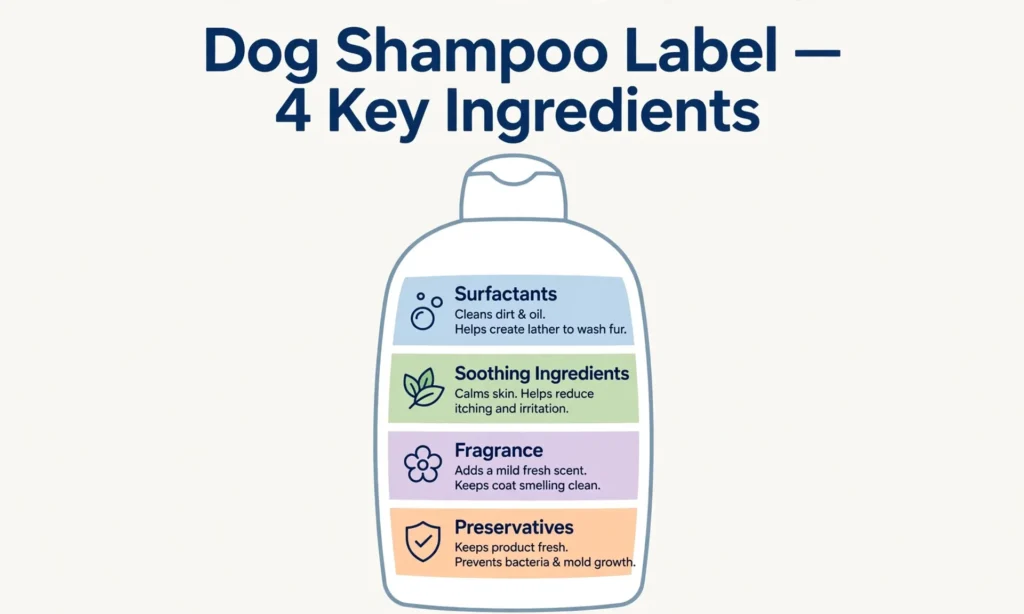
Check the manufacturer’s complete ingredient disclosure and applicable labeling rules; do not assume every pet shampoo label follows human-cosmetic ordering rules.
- Surfactants come first. These are the cleansers. Mildness depends on the finished formula, concentration and use; a plant-derived surfactant is not automatically gentle. A harsh, high-concentration sodium lauryl sulfate (SLS) wash is a poor first choice for sensitive skin, not because SLS in a rinse-off product is automatically toxic, but because it is needlessly stripping when gentler cleansers exist. Lather is not a measure of cleaning power: a low-lather formula can clean perfectly well, and owners who add more product because “it isn’t lathering” are the ones who end up with residue.
- Soothers come next. Colloidal oatmeal and aloe are the two soothers with the best support in this guide’s sources. Their job is comfort, not cure: oatmeal soothes, it does not diagnose or treat skin disease, and no soothing ingredient turns a grooming shampoo into a medicated one.
- Fragrance is where the risk hides. Vague “fragrance” or “parfum” can cover dozens of unnamed scent chemicals, which is why a reactive dog’s bottle should name its scent ingredients or have none at all. A named botanical scent (lavender, coconut, lime) is at least identifiable, so you can learn whether your dog reacts to it.
- Preservatives are not automatically a villain. A water-based shampoo with no preservative at all carries its own risk, because an unpreserved bottle can grow microbes once opened. Do not praise “preservative-free” blindly, and do not fear a named, recognised preservative on a short list. As a precaution for reactive dogs, avoid formaldehyde releasers (such as DMDM hydantoin and diazolidinyl or imidazolidinyl urea) and the combination of MEA with cocamide DEA. “Avoid as a first choice” is the honest wording, not a claim that these are proven poisons in a rinse-off product.
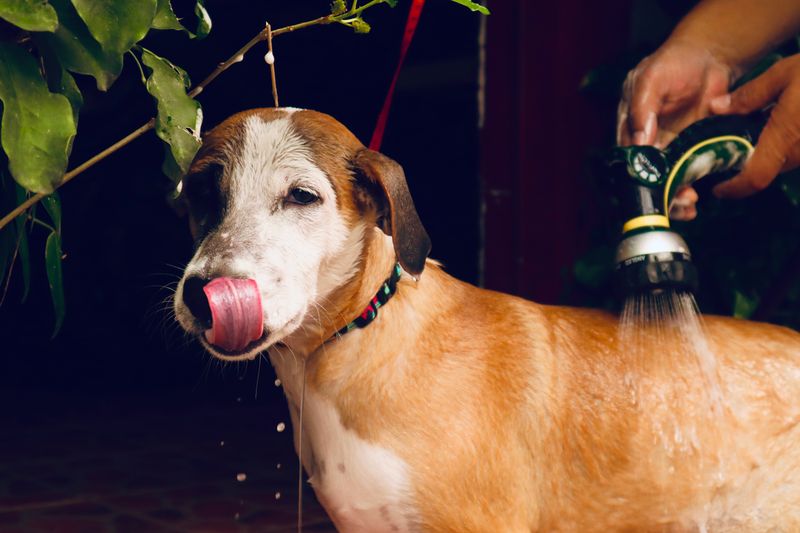
- Rinseability is the step most owners skip. A shampoo that does not rinse out completely leaves a film on the coat and skin, and that film itches. Rinse until the water runs clear, then rinse once more on a dense coat. If the coat still feels slick or coated after rinsing, the formula is too heavy for that dog, however “natural” its label claims to be.
Fragrance-Free vs Scented
Fragrance can be a potential irritant for an individual dog; fragrance-free options are worth discussing with your vet when reactions are suspected. A scented formula is not automatically harmful: a healthy, non-reactive dog can enjoy a lightly scented wash without any problem. The mistake is using a scented formula as the first test on a dog whose skin you already know is reactive, and then being unable to tell whether the scent, the cleanser, or the underlying skin problem caused the reaction that follows.
Essential-oil scent deserves its own warning. Concentrated essential oils are a separate hazard around dogs. Tea tree oil in particular is excluded from every product in this guide’s shortlist, and no essential oil should ever be added to a bottle at home. If a “natural” shampoo lists tea tree, peppermint, or any other essential oil as a hero ingredient, treat it as a scented product with an extra safety question attached, not as a gentler one. Puppies, pregnant dogs, and dogs with breathing problems need a vet check before any scented formula.
For a dog with suspected product sensitivity, consider a dog-formulated shampoo without added perfume and follow the label. Persistent itching after bathing warrants veterinary assessment.
Colloidal Oatmeal and Sensitive-Skin Products
Colloidal oatmeal is finely ground oat, milled so it disperses in water and coats the skin evenly. Ordinary oats should not be assumed equivalent to a tested veterinary formulation. In a shampoo, its role is comfort: it soothes the feeling of dryness and mild itch during and after the bath, and it pairs well with aloe for the same reason. What it does not do is treat the cause of the itch.
If a dog’s itch comes from allergy, infection, parasites, or a skin condition, an oatmeal wash may make the dog feel better for a day while the cause continues underneath. That is why persistent itch is a vet question even when an oatmeal shampoo seems to help. Colloidal-oatmeal products may be used for comfort in selected routine-care situations, but an itch that persists or worsens may reflect allergies, infection or parasites requiring diagnosis.
A greasy coat with a yeasty smell is not a “dry skin” problem to be solved with a richer oatmeal wash. It is a sign to see a vet, because yeast and bacterial overgrowth need diagnosis, not a different bottle.
Colloidal-oatmeal products may be used for comfort in selected routine-care situations, but an itch that persists or worsens may reflect allergies, infection or parasites requiring diagnosis.
Sarah Lauren’s
Clarifying vs Moisturising vs Medicated
Clarifying shampoos clean harder: they strip grease, build-up, and smell. Use one when the dog is genuinely greasy or dirty, not as a routine wash, and never as a first wash on sensitive skin. A clarifying wash on an already irritated coat is how a mild problem becomes a raw one.
Moisturising shampoos add oils and butters to replace what washing removes. They suit genuinely dry coats, best paired with a conditioner step rather than loaded into a single heavy wash. The failure mode is residue: a coated coat itches, which owners read as “still dry” and treat with more moisturiser.
Medicated shampoos are not a third point on the same scale. They contain an active ingredient matched to a diagnosis (antifungal, antibacterial, or another vet-chosen active) with a contact time and treatment plan set by the vet. A grooming shampoo, however “natural”, is not a weaker substitute for one, and a medicated shampoo is not a stronger grooming wash. The boundary is the diagnosis: no diagnosis, no medicated shampoo; diagnosis, and the vet’s label instructions outrank everything in this guide.
How to Patch Test a New Shampoo
A patch test is a small trial before a full bath. This is a general home-care approach; if your dog has reactive skin, ask your vet first.
- Mix the shampoo exactly as the label directs (dilute only if the label says to).
- Apply a small amount to one small area of healthy skin, such as the side of the chest or inner thigh, away from the face, eyes and any irritated skin.
- Leave it for the label’s contact time, then rinse the area completely with lukewarm water.
- Watch that area for 24 hours for redness, bumps, flaking, or scratching.
- If the skin stays calm, go ahead with a full bath. If any sign appears, do not use the product and call your vet if it persists.
Current Product Comparison Method
Every product below gets pros and cons, and the same three checks apply to all of them: patch test before a full bath, rinse until the water runs clear, and stop at the first sign of a reaction. For what else belongs in the wash routine, see the complete home dog grooming kit guide.
Our Natural Dog Shampoo Picks
Matched to skin and coat need, so you can start with the simplest formula that fits.
| Product | Type | Best for | Price |
|---|---|---|---|
| earthbath Oatmeal & Aloe, Fragrance Free | Oatmeal, fragrance-free | Routine dry, itchy, or sensitive skin | Check listing |
| 4-Legger Organic Unscented Hypoallergenic with Aloe | Fragrance-free, organic | Highly reactive or fragrance-sensitive dogs | Check listing |
| Burt’s Bees Oatmeal with Colloidal Oat Flour & Honey | Oatmeal, budget | Low-cost routine bathing | Check listing |
| Wahl Dry Skin & Itch Relief, Oatmeal (Coconut Lime Verbena) | Oatmeal, scented, concentrated | Healthy, non-reactive dogs that need a plant-based oatmeal wash | Check listing |
| TropiClean Hypoallergenic Gentle Coconut Puppy & Kitten | Hypoallergenic, puppy-labelled | Puppies 12 weeks and older, mild routine cleansing | Check listing |
When you compare any shampoo, check four things: the exact variant, whether it is fragrance-free or scented, the minimum age on the label, and the directions for dilution and contact time.
earthbath Oatmeal & Aloe — Fragrance Free variant
The clearest label in the shortlist: colloidal oatmeal, organic aloe vera, and plant-derived, coconut-based cleansers, soap-free and pH-balanced, for pets over 6 weeks, usable as sold or diluted up to 10:1, with a 90-second minimum contact time on the retailer listing. Name the Fragrance Free variant explicitly when you buy it: the scented Vanilla & Almond variant is a different list with added botanical fragrances, and buying the wrong variant undoes the whole reason for choosing this bottle.
- Clearest dilution and contact directions in the set.
- A genuinely fragrance-free option exists.
- The manufacturer states it will not wash off topical flea treatments.
- A vet-reviewed roundup removed it from its list after a flaky-coat result and concerns about the preservative and fragrance content of the variant it tested — reported here honestly, because any product, including a “natural” one, can irritate an individual dog.
4-Legger Organic Unscented Hypoallergenic Dog Shampoo with Aloe
The shortest verified list in the shortlist: saponified organic coconut, olive, and jojoba oils plus organic aloe vera and rosemary extract, with no synthetic fragrance, no essential-oil fragrance, no sulfates, parabens, phthalates, dyes, or synthetic preservatives, certified to USDA organic standards, for puppies 8 weeks and older, diluted in a foamer bottle and left for 1–2 minutes before a complete rinse.
- Fewest suspects if a reaction appears.
- The named product is marketed as unscented; confirm the exact ingredient list and avoid absolute claims across all products.
- Third-party certification rather than a self-declared “natural” claim.
- Thin, low-lather feel that needs water to activate — owners must be told, or they will over-apply it.
- Premium price band.
- The scented 4-Legger formulas are not interchangeable with this one, so do not buy a scented variant by mistake.
Burt’s Bees for Dogs Natural Oatmeal Shampoo with Colloidal Oat Flour & Honey
The budget pick of the set: colloidal oat flour, honey, beeswax, and green tea extract, with no added artificial fragrance, sulfate- and paraben-free, pH-balanced for dogs, and a light lather, ready to use with no dilution listed.
- Lowest comparison-time price in the set.
- Simple, recognisable hero ingredients.
- Widely available.
- The full ingredient list conflict is unresolved at the time of writing.
- Honey and beeswax may matter for individual sensitivities.
- Light lather is not a defect, but owners often misread it as “not working” and use too much.
Wahl Dry Skin & Itch Relief / Oatmeal Shampoo (Coconut Lime Verbena)
A plant-based oatmeal option for healthy, non-reactive dogs: oatmeal, coconut, lime, aloe, and lemon verbena, PEG-80 free, sold as a concentrate so a small amount goes a long way, with the manufacturer’s own instruction to stop use if irritation occurs.
It is scented, so it suits healthy, non-reactive dogs rather than reactive ones. “Itch Relief” is the product’s name, not a treatment: itching that keeps coming back needs a vet.
- Concentrated, so a bottle lasts.
- PEG-80 free.
- Plant-based oatmeal formula.
- Scented, so a poor first test for a reactive dog.
TropiClean Hypoallergenic Gentle Coconut Puppy & Kitten Shampoo
The age-labelled pick: tearless, pH-balanced, mild coconut cleansers with colloidal oatmeal, aloe, and vitamin E, a light coconut fragrance, massaged for 3–5 minutes and rinsed completely, with the current large-size listing stating 12 weeks or older.
- Puppy-labelled and tearless.
- Named, identifiable scent.
- Colloidal oatmeal and aloe.
- Scented despite the “hypoallergenic” label.
Products for Long, Curly and Double Coats
Coat type changes how a shampoo behaves. A dense double coat needs the formula worked through to the skin, section by section, with water doing most of the work. A thin, low-lather formula is not failing on a double coat; it is asking for more water and more sectioning, not more product.
A curly coat tangles more easily when wet, so the shampoo step should always be followed by a conditioner step; the homemade dog conditioner recipes guide covers that pairing. A fine or short coat shows residue fastest, so heavy butter formulas are the riskiest choice there, however gentle they sound.
One rule overrides all coat advice: never bathe a matted coat. Water tightens mats, so a matted dog needs detangling or a groomer first, and a bath second. If a comb cannot pass through the coat before the bath, the bath should wait.
What to Avoid if Your Dog Is Itchy?
- Tea tree oil and other concentrated essential oils on the coat. Concentrated tea tree oil is a documented hazard for dogs, and a shampoo that lists it as a hero ingredient is not a natural remedy, it is a risk. The same caution applies to any essential-oil-led formula marketed for itchy skin.
- Vague “fragrance/parfum” on a reactive dog. If the scent chemicals are unnamed, you cannot learn which one your dog reacts to, or avoid it next time.
- Human shampoo or dish soap as a routine wash. Dog skin pH runs 6.2–7.4 against human skin at 5.5–5.6, and human shampoo disrupts the acid mantle that protects a dog’s skin, leaving it dry, flaky, and more vulnerable. A one-off emergency wash is different from a routine.
- Harsh, high-concentration SLS as a first choice for sensitive skin. Not a proven poison in a rinse-off product, but a needlessly stripping choice when gentler cleansers exist.
- Any medicated active without a vet diagnosis. An antifungal or antibacterial shampoo bought because it “sounds stronger” is treatment without a diagnosis, and it can mask the condition it was supposed to treat.
- The shampoo-switching trap. If three gentle formulas in a row do not help, the problem is probably not the bottle. Keep switching and you keep resetting the patch-test clock while the real cause (allergy, infection, parasites, or a skin condition) goes undiagnosed.
When You Need a Medicated Shampoo Instead?
You need a medicated shampoo only when a vet has diagnosed a condition that a medicated active treats. That is the whole rule. The vet chooses the active, sets the contact time, and sets the treatment plan; your job is to follow the label and the vet’s instructions, not to rotate medicated washes casually with grooming shampoos or step up to a medicated bottle because a grooming shampoo “didn’t work”.
If you are unsure whether your dog’s skin problem has crossed from grooming territory into medical territory, our guide on whether home dog grooming is safe sets out the same boundary: grooming handles clean, healthy skin, and anything beyond that belongs to a vet.
Bring the shampoo bottle to the appointment, and be ready to say what you used, how often, and when the signs started. That history shortens the examination and avoids a repeat of the wrong product.
Veterinary guidance note: Medicated shampoo is treatment selected for a diagnosed condition. Follow the veterinarian’s specific contact time and bathing frequency; seek care for worsening redness, discharge, pain or persistent itch.
Pros and Cons of Choosing a Natural Shampoo
- Simpler ingredient lists, with fewer synthetic fragrances and additives to react to, which makes a reaction easier to trace.
- Recognisable hero ingredients — oatmeal, aloe, coconut-based cleansers — whose roles you can actually understand from the label.
- Third-party certifications, where they exist, give you an audited claim instead of a marketing word.
- Gentler cleansing that suits routine bathing for healthy skin, without stripping the coat’s natural oils as aggressively as a harsh wash.
- No safety guarantee: “natural” is unregulated, and a plant-derived ingredient can still irritate an individual dog.
- Usually a higher price per ounce, and comparison-time prices age fast, so “best value” claims in other roundups should never be taken at face value.
- Gaps in the range: the gentlest natural formulas are rarely the right answer for greasy, smelly, or medically troubled coats, and pretending otherwise delays the vet visit that would actually help.
Frequently Asked Questions
Conclusion
The best natural dog shampoo is not the bottle with the most botanicals or the loudest “natural” claim. It is the simplest formula that matches your dog’s skin and coat, bought as the exact variant named on its label, patch tested before a full bath, and rinsed until the water runs clear — with a vet visit, not another bottle, as the answer whenever the skin tells you something is wrong.
Start with that rule, and the shortlist above becomes a choice you can defend rather than a gamble. For the full routine that puts the shampoo step in its proper place, start with the complete guide to grooming your dog at home.
References
- American Kennel Club — Can You Use Human Shampoo On Dogs?
- American Kennel Club — How to Groom a Dog
- ASPCA — Dog Grooming Tips
- VCA Animal Hospitals — How to Bathe Dogs with Medicated Shampoo
- Petful — Best Dog Shampoo
- Hepper — 9 Best Organic & Natural Dog Shampoos of 2026
- BetterPet — The best shampoos for your dog’s dry, itchy skin
- HoundTherapy — Best Natural Dog Shampoo for Safe, Healthy Skin & Coats
- 4-Legger — Best Organic Dog Shampoo for Sensitive Skin